
Two focus groups and 26 interviews outline the profile of the EQF level 5 technician that the MeDCare project will develop.
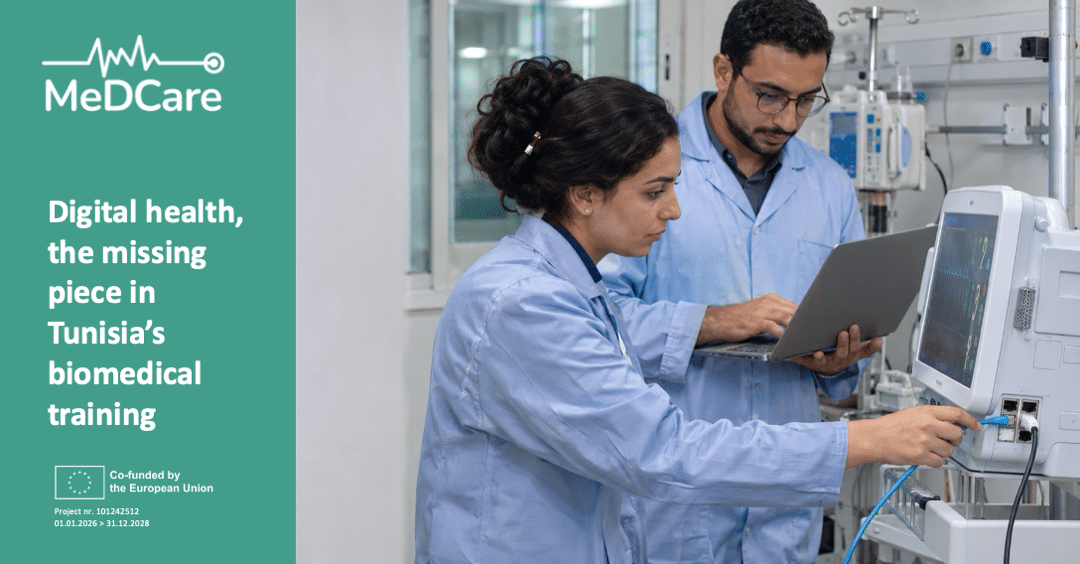
In an intensive care unit, a monitor stops sending data to the nurses’ station. The fault could lie in the device itself, in the network, or in the software that links it to the hospital information system. Working out which falls to a biomedical technician, whose job increasingly runs through a network, a database and a remote connection to the supplier.
What does this technician need to be able to do in Tunisia, and how well does current training prepare them? That is the question behind “Healthcare Technology Competences and Barrier Analysis in Tunisia”, a research report from the MeDCare project, co-funded by the European Union through the Erasmus+ programme. It draws on three sources: a desk study by ATFP, the Tunisian Agency for Vocational Training; two focus groups with thirteen experts from institutions and industry, organised by the vocational training provider Elemtiez; and twenty-six interviews with healthcare organisations, the training centre and public authorities, carried out by the NGO ATAS.
The starting point is a qualification that already exists, the Brevet de technicien supérieur in biomedical equipment maintenance. It is offered by a single public centre, in Tunis. The programme in use dates from 2008, while a 2019 revision is still awaiting accreditation. In mid-2024 the public sector employed 234 biomedical technicians, roughly two in three of them women.
The research opens with a confirmation. Biomedical engineering principles, maintenance, calibration and testing are rated essential by both expert groups and are already part of the training, although coverage is judged only partial and the equipment is ageing. This is also what healthcare organisations ask for first. In the report’s view, the new profile should build on this foundation and bring it up to date, not replace it.
The gap opens up on the digital side. The experts rated seven digital health competences as essential or important, from connected medical devices and telemedicine to electronic health records and data protection. On an eighth, cybersecurity, they were divided, while agreeing that a basic level is needed. None of these eight competences appears in any module of the current programme, nor of the 2019 revision. Yet six already feature in what healthcare organisations expect when they recruit: connected devices, for instance, were mentioned by eight of the fifteen interviewed. According to the report, this is the decisive gap between today’s diploma and the profile that is needed.
Several organisations also want autonomy. One maintenance manager put it simply: what is needed is a technician who can analyse a problem before calling the supplier. They also want communication skills, meaning the ability to document interventions and to talk to doctors, nurses and suppliers. For four of them, this is the main shortcoming of the technicians they employ today.
Why is digital missing? The report describes a single mechanism: technology moves faster than the programme, the equipment and the trainers can follow, and lengthy procedures slow down every correction. Much of the training equipment dates from when the centre opened, around 2000. Trainers are few, some of the most experienced are nearing retirement and, by their own account, continuing development for teaching staff is almost non-existent.
There are, however, foundations to build on. A network of placements with hospitals and companies is in place, suppliers train staff on new equipment, and some hospitals have already introduced electronic health records. Three trainers consider the centre close to ready for digital health, provided that the trainers are prepared and the right tools arrive.
From this evidence the report derives a draft profile for a Medical Technology & Digital Health Care Technician at level 5 of the European Qualifications Framework, organised into seven units. At its core are the maintenance and diagnosis of equipment and the management of connected devices and information systems. Around them sit quality and regulation, communication with clinical staff, autonomy, data protection and an orientation towards emerging technologies. These include an introductory grounding in artificial intelligence applied to maintenance, the only new competence proposed by both expert groups. It is a working basis, not a finished curriculum: the modules, assessment and certification will be developed in the project’s next phase.
Among its recommendations, the report calls for trainers to be trained before the digital units are taught, and suggests that these units could also be offered as micro-credentials to technicians already in post. It advises the authorities to link the national qualifications framework to the European one. And it takes up a proposal from a senior ministry official: mutual recognition with Italy for this qualification, starting with the MeDCare double degree.
The report was written by OpenCom, with contributions from all the project partners, and is available in open access under a Creative Commons CC BY-NC-SA 4.0 licence at https://doi.org/10.5281/zenodo.23646819.
It now passes to those designing the curriculum, work led by ITS per le Nuove Tecnologie della Vita in Bergamo together with CIPFP Vicente Blasco Ibáñez in Valencia.
Back to the monitor that has stopped sending data. Getting it working again still calls for the practised hands of a traditional technician. But it also calls for an understanding of what is happening across the network. According to the report, today’s training makes room for the first, even if it needs strengthening. It does not yet make room for the second. MeDCare is working to close that gap.
Link: www.medcare-project.eu
Co-funded by the European Union. Views and opinions expressed are however those of the author(s) only and do not necessarily reflect those of the European Union. Neither the European Union nor the granting authority can be held responsible for them.
Images generated using artificial intelligence (AI). The people shown are not real.