
Focus groups and in-depth interviews: the Erasmus+ project SHE-GROWS hears from 44 people in Béja and Jendouba
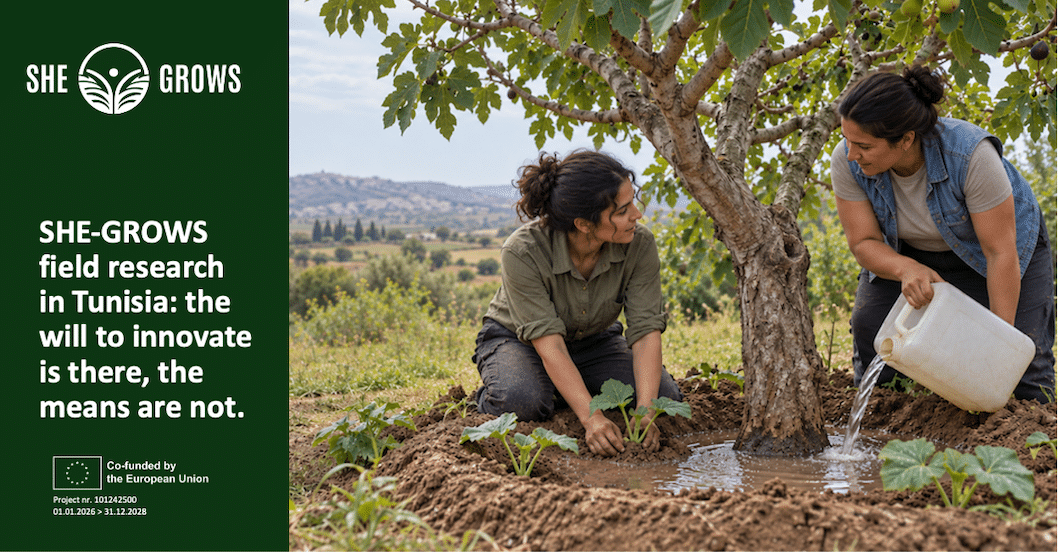
In the farmland of north-western Tunisia, no water goes to waste, not even the water given to the trees. Around each fig tree is a shallow basin that catches the irrigation water. Some women farmers use it to grow squash and similar crops. The same water, which in some areas is carried by hand or bought from tanker lorries, feeds two crops instead of one. It is a traditional technique, and it says a great deal about the people who use it.
It is one of the practices documented by the qualitative research of SHE-GROWS, a project co-funded by the European Union under the Erasmus+ programme (project no. 101242500). Alongside a survey that gathered more than a thousand responses and consultations with local stakeholders, the project set out to listen to people at close quarters. In April 2026 the Tunisian partners held two focus groups, in other words guided group discussions, run as separate sessions: six women in Ain Draham, eleven men in Jendouba. Twenty-seven in-depth interviews with rural women and agricultural practitioners in the governorates of Béja and Jendouba completed the picture. In all, 44 people took part, and their accounts are brought together in a report completed in September.
One finding runs through the entire study, and it concerns who these women are. None of the sources portrays them as unmotivated, wary of innovation or inexperienced. What emerges instead is a picture of people who know their work inside out and are looking for new ways forward. The obstacles, the authors conclude, are chiefly material and institutional. What is missing is capital, water, equipment and access to markets, along with support that does not stop halfway.
The two obstacles cited most consistently are money and water. In the focus groups, participants ranked eight obstacles, partly different for each group, from most to least serious. On average, the women put lack of investment capital first, followed by water, then land to farm. For the men, too, capital was among the two most serious obstacles. The interviews show how that constraint plays out in everyday life. Some women turn to loans from solidarity banks; others sell their jewellery to pay for irrigation. And when asked what it would take to try something new, the answer given most consistently is money, not knowledge or motivation.
Equally striking is the way these women hold old and new together. They do not choose between traditional and modern farming. They go on using local seeds, compost and manure, and water-saving techniques such as the one around the fig trees. At the same time they want to learn hydroponics, growing plants without soil in nutrient-enriched water, which needs far less water. Several interviewees describe it as a potentially radical answer to the shortage of water and land. But they are quick to name the conditions: funding, infrastructure and institutional backing.
On one point, however, women and men part company: how much weight to give to training. For the men in the focus group, lack of training and technical support was, on average, the most serious obstacle, just ahead of capital. The women placed it much lower, sixth out of eight, and their views varied widely. That does not mean training matters little to them: in the interviews, demand for it is strong and specific. It means that, when forced to choose, the women in the focus group put material resources first. The authors treat this difference as a finding in its own right, not as an inconsistency to be explained away.
Social norms, too, tell a less predictable story. Within families, farming decisions are mostly taken jointly by husband and wife. In beekeeping and poultry farming, where women often know more than the men of the household, it is the women who lead. Land and larger investments, on the other hand, more often remain in the hands of husbands or older relatives. Some younger women who still live with their parents say they have less of a say. In the focus groups, traditions and social expectations ranked on average among the least serious obstacles, but the average hides sharply opposing views. Of the six women, four put them at the bottom of the list and two at the top. For the authors, cultural constraint is real, but its weight varies from one person, and one family, to the next.
The lever to build on is already there: women’s groups and agricultural development associations. Many of the women interviewed belong to one. They describe them as places to learn, to support one another, to share equipment and to sell together, including at fairs and national events. They say that husbands and other men in the community, having seen the benefits, now look more favourably on their involvement. The men’s focus group points the same way: it described rural women as essential to farming, and some participants called them key to the success of agricultural projects. The catch is that institutional support often amounts to little more than encouragement. What the groups need is land, premises, machinery, permanent sales outlets and funding.
For SHE-GROWS, these findings are a working brief. Coordinated by EFA El Soto in Spain, the project brings together OpenCom (Italy), Libverda (Czech Republic) and three Tunisian organisations: ELEMTIEZ, Grow It Yourself and the Tunisian Union of Agriculture and Fisheries (UTAP). It aims to train and certify 60 people from rural areas, at least half of them women, in hydroponic farming and sustainable entrepreneurship, leading to the creation of a cooperative. From the interviews, the authors draw specific recommendations for the consortium. Training should take place close to the villages, at times that fit around caring for the family and working in the fields, in Tunisian Arabic and with plenty of hands-on practice. It should combine technical skills with selling, digital tools and running a cooperative. And it should not stop at the last lesson, because equipment, pilot installations and ongoing mentoring are needed. Finally, women’s groups should be involved as partners in designing the programme, not merely as channels for reaching participants.
These findings should be read with caution, as the report itself is the first to point out. Each focus group was a single session in a single place, and the women’s group had just six participants. The interviewees were not randomly selected: many already belong to groups and associations. The conversations took place in Tunisian Arabic and were translated into English, so some nuance may have been lost. That is why the analysis focuses on recurring themes rather than individual remarks. This is in-depth listening, not a statistical snapshot.
The report was written by OpenCom, which coordinates the project’s needs analysis, drawing on the fieldwork carried out with the Tunisian partners. It concludes the qualitative strand of the research and feeds, together with the survey and the consultations with local stakeholders, into a single gender-responsive mapping report. That report will be the foundation on which the consortium builds its training programme. Updates on the project are available at shegrowsproject.eu.
Which brings us back to the basin at the foot of the fig tree. The woman who plants squash there does not need anyone to tell her what water is worth. She needs what she cannot secure on her own: capital, equipment, a market, and someone who stays on after the course has ended. That is the measure by which SHE-GROWS will be judged.