
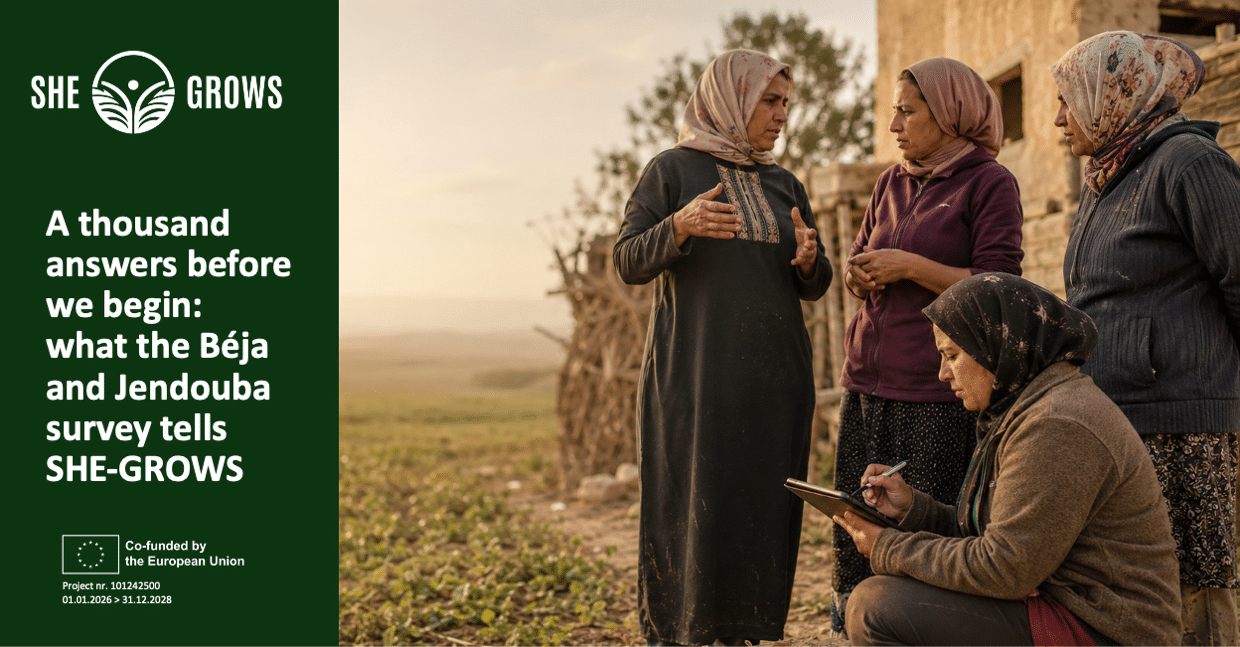
The Erasmus+ project SHE-GROWS has completed the quantitative analysis of its baseline survey in the Tunisian governorates of Béja and Jendouba. The 1,038 responses gathered from rural and farming households describe a context where agriculture still anchors the household economy, but where water, markets and access to inputs are all under strain. The report is not a box-ticking exercise. It is there to reshape the training before the training starts.
The starting point is unambiguous. For 82 per cent of respondents, farming is the household’s main source of income. Any intervention here touches how families survive, not a side activity. Hence the report’s first warning: hydroponics cannot be introduced as a demonstration exercise. It has to solve a problem people already have.
That problem has a name. The large majority rate the effect of water scarcity on production over the past three years as moderate to high. Very few consider it negligible. Alongside water come drought, heat stress, erosion, pests and falling yields. The report advises placing hydroponics inside a broader climate resilience package rather than offering it as a standalone fix.
A quieter constraint is just as decisive. Only 40 per cent report any access to markets. If three in five struggle to sell, higher output will not become higher income. The report therefore asks that training cover costs, pricing, packaging, market mapping and collective selling from the outset. On inputs, 53.1 per cent report difficulty obtaining seeds, fertiliser and tools.
On women, the findings dismantle an easy reading. The barriers most often cited are access to credit, lack of training, domestic workload, access to land and limits on mobility. Cultural norms and social disapproval appear, but they do not dominate. The obstacles are largely material and organisational, which means that timings, venues, transport and childcare are not logistics. They are the conditions of participation.
Training is where the ground is most favourable. Eighty per cent have already attended vocational or non-formal courses, and appetite for learning is real. Forty per cent would prefer a fully online course and 28 per cent a blended one. Yet only 64.5 per cent have access to a digital device, and confidence with smartphone learning tends to sit at a middling level. A digital-only model would leave a substantial group behind. Afternoons suit 43 per cent, weekends 35 per cent.
Two figures set the sequence of the work. Seventy-three per cent had never heard of hydroponics, while 79 per cent express at least moderate interest in learning it. And cooperatives, the backbone of the project, currently involve 10.5 per cent of respondents, with 45 per cent undecided about joining a new one and just 3 per cent ruling it out. Asked what they expect from training, respondents put professional skills, food for the household, income and water savings first. Joining a cooperative comes last. That is not a rejection. It is a method note. The cooperative should be built as a way to reach those outcomes, not offered as an end in itself.
The report is candid about its own limits. The questionnaire ran online, so people with poor digital access are probably underrepresented. The findings will need to be triangulated with focus groups and field consultations before the training design is finalised.
SHE-GROWS is a capacity building project in vocational education and training, co-funded by the Erasmus+ programme. It is coordinated by EFA El Soto (Spain) and brings together OpenCom (Italy), Libverda (Czech Republic), ELEMTIEZ, GIY and UTAP (Tunisia), with the support of Tunisian associated partners. It sets out to train women in rural Béja and Jendouba in hydroponic farming and cooperative enterprise, through a qualification recognised in both Europe and Tunisia.
The report will shortly be available on the project website: shegrowsproject.eu
Co-funded by the European Union. Views and opinions expressed are however those of the author(s) only and do not necessarily reflect those of the European Union or the European Education and Culture Executive Agency (EACEA). Neither the European Union nor the granting authority can be held responsible for them