
Think about what you would pack for a month away. Clothes, shoes, and the charger you always forget. Cristian Constantin packed something else as well: a doctorate, and a question this big: how do you measure something you cannot see?
Cristian is just past thirty, comes from Bucharest and studies air for a living. Yes, air, the stuff we breathe without a second thought. He works at ECOIND, Romania’s national institute for industrial ecology, and is completing his doctorate at the University of Technology. His job is to take something invisible, emissions in the atmosphere, and turn them into numbers. Sampling, data, and mathematical models. Because a number, unlike an impression, is something you can put on a table and discuss. Whoever has to make decisions can start from there.
But what was he doing in Arezzo? This is where OpenCom comes in, the Arezzo-based centre for research into transferable skills, and a partner in a European project whose name says it all: Talent Pass. The idea is simple and slightly revolutionary. Researchers, as a rule, leave in order to grow. They leave their country and often never return. Talent Pass tries to reverse that: to move people and their skills between universities and companies across half of Europe, so they can grow where they are rather than be lost for good. Ten partners, seven countries, almost three million euros. In this whole network, OpenCom is the only Tuscan member.
In Arezzo, Cristian was not there to watch from the sidelines. For four weeks, he trained in everything a good researcher is usually never taught: how to manage a European project, what the circular economy really is, how to use artificial intelligence tools, and how to communicate what you discover. In short, how to get science out of the laboratory, which is the finest place in the world but also the one with the smallest windows.
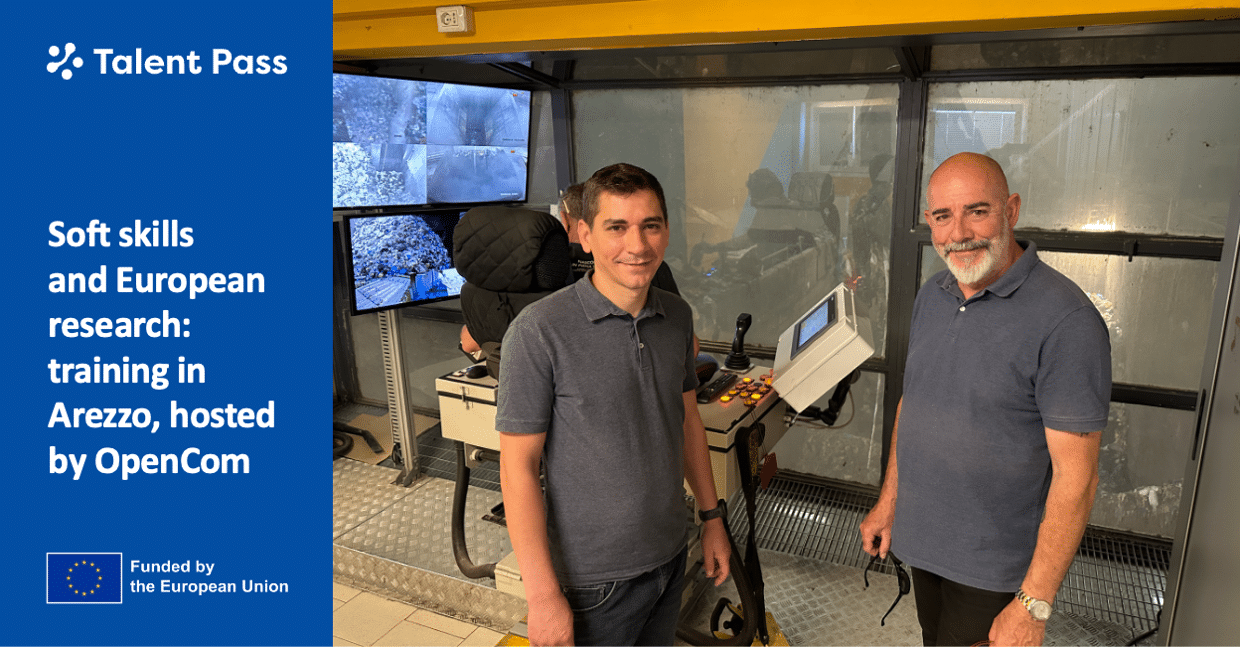
There was a day out, too. OpenCom took him to San Zeno, to the AISA Impianti technology hub, where its president, Giacomo Cherici, showed him around: from waste recovery to the production of biogas and electricity. Two worlds talking to each other: the world of those who do research, and the world of those who keep an industrial plant running every day. Out of that conversation came a mutual interest, the kind that sometimes, further down the line, turns into something. It is exactly the kind of encounter and experience that this should bring about, and one that otherwise would never have happened.
In the end, the best person to say how it went is Cristian himself: “Four weeks ago I arrived in Arezzo as a secondee. Today I leave as a better researcher and a more confident project manager,” he said before heading home, thanking the OpenCom team for an experience he would carry into his work and his institution.
Here comes the best part. Cristian is only the first. Between now and 2029, ten more Talent Pass researchers will pass through Arezzo, along with another twenty from other European projects that OpenCom will host for training. For quite some time, a city like Arezzo will be a regular stop on a scientific network spanning the continent.
Talent Pass is co-funded by the European Union.