
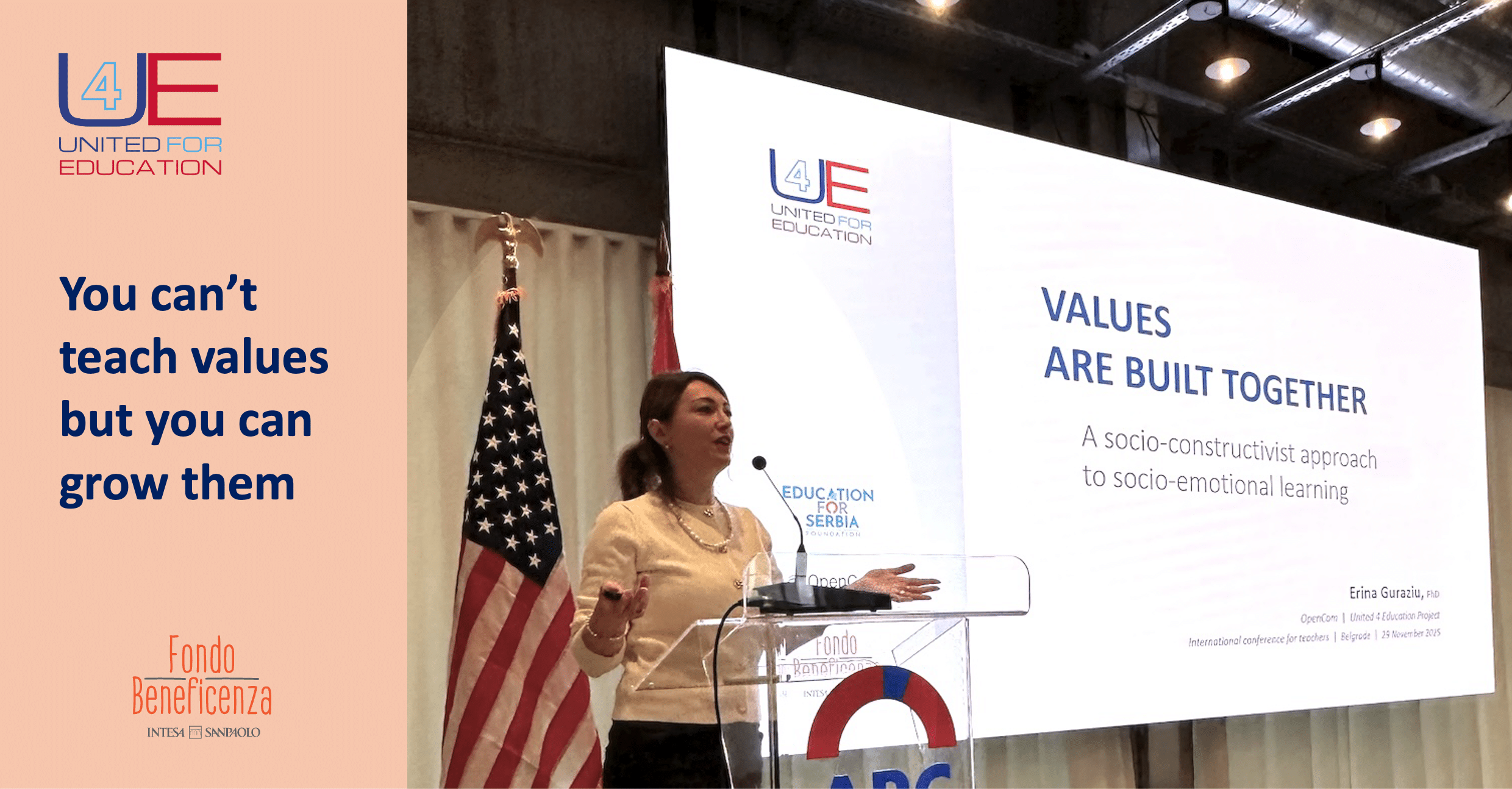
At the closing conference of the United 4 Education project in Belgrade, researcher Erina Guraziu presented a socio-constructivist approach to emotional learning, one that sits remarkably well with what neuroscience tells us about how the brain actually learns.
“Can you learn to ride a bicycle by reading a manual?” With this deceptively simple question, Erina Guraziu, researcher and president of OpenCom, opened her address to an audience of over a hundred teachers from across Serbia. The answer, of course, is no. But behind this apparent truism lies a quiet revolution in how we think about teaching values.
The occasion was Pedagogical Innovation, an international conference marking the conclusion of the United 4 Education (U4E) project, held at Belgrade’s Ložionica venue. This ambitious initiative, funded by Intesa Sanpaolo’s Fondo Beneficenza and led by OpenCom in partnership with the Education for Serbia Foundation, has trained 20 young edu-leaders and reached over 5,000 pupils in ten high-need schools across the Balkan nation, all within just fifteen months.
Learning together, learning by doing
Guraziu’s presentation, titled “Values Are Built Together: A Socio-Constructivist Approach to Socio-Emotional Learning,” emphasized a key principle in educational theory: values cannot be transmitted like information; they must be experienced.
“Empathy, resilience, leadership, they work just like riding a bicycle. You don’t learn them by listening. You learn them by doing, by experimenting, by being with other people.”
The bicycle metaphor neatly captures why social-emotional skills, by their very nature relational, demand social contexts for learning and cannot develop in isolation. Think about how you learnt to cook, Guraziu suggested, probably not from a recipe book, but by watching someone else, having a go, making mistakes, getting feedback. The same holds for values: children don’t learn respect because we tell them to be respectful; they learn it by seeing respect in action around them.
What brain science tells us
Guraziu’s approach finds strong support in contemporary neuroscience. When we learn through emotionally meaningful experience, we activate what researchers call the amygdala-prefrontal cortex circuit: the amygdala, our brain’s emotional hub, flags up what matters, whilst the prefrontal cortex regulates our response and consolidates the learning. It amounts to an ongoing conversation between the oldest and most recently evolved parts of the human brain.
There is more. In the 1990s, Giacomo Rizzolatti’s team at the University of Parma discovered mirror neurons, nerve cells that fire not only when we act, but also when we observe someone else performing the same action. This finding transformed our understanding of empathy: mirror neurons allow us to simulate another person’s emotional state internally. They provide the biological foundation for the observational learning that Guraziu describes as essential to the development of values.
Then there is neuroplasticity, the brain’s capacity to reorganise itself by forming new neural connections. MRI studies show that repeated practice of social-emotional skills increases grey matter density in brain regions associated with attention and emotional regulation. The brain, quite literally, reshapes itself in response to meaningful experience.
Gardeners, not broadcasters
The central metaphor of Guraziu’s presentation cast educators as gardeners. ‘We are not broadcasters of values,’ she argued. ‘We are gardeners. A gardener doesn’t make a plant grow. A gardener creates the right conditions, the soil, the light, the water, and the plant grows by itself.’
A poetic image, certainly, but one with solid scientific grounding. The brain’s limbic system contains receptors for two opposing hormonal systems: the stress response (cortisol) and the bonding response (oxytocin). Neurobiological research demonstrates that when stress dominates, cortisol impairs effective learning. Supportive, trusting environments, by contrast, promote oxytocin release, which facilitates connection and learning. Guraziu’s ‘right soil’, it turns out, has a precise neurochemical correlate.
United 4 Education: theory into practice
Guraziu’s presentation was far from purely theoretical. The U4E project has served as a real-world testing ground for these principles. The programme selected and trained 20 young people through 120 hours of intensive preparation, with academic support from Cambridge Assessment International Education. These ‘edu-leaders’ then took up posts in ten Serbian schools facing significant educational disadvantage.
The real innovation, however, lay in their role: the edu-leaders entered schools as facilitators, not instructors. Their task was to create spaces, activities and experiences in which pupils could develop social-emotional skills through collaboration on real projects with genuine social impact.
“We didn’t teach empathy. We created the conditions for empathy to emerge and grow. When students work together on something that genuinely matters, they naturally develop these skills, not because we teach them, but because they need them to succeed together.”
“Values are caught, not taught”
Guraziu closed by invoking an old educational maxim: values are caught, not taught.
“Our students won’t learn empathy from our lessons. They’ll catch it from the environments we create, from the experiences we design, from the way we treat them and one another. My message is simple: don’t try to teach values. Create the spaces where values can be lived.”
It is a message that now finds fresh support from science. Research into mirror neurons, neuroplasticity and the brain’s emotional circuitry offers a scientific framework for the socio-constructivist approach adopted by the U4E project, a pedagogical model that aligns with what we now understand about how human beings actually learn.
By the close of the day, the project’s achievements spoke for themselves: 5,000 pupils engaged, 20 educators trained, 20 social impact projects launched. Yet the most significant figure remains invisible: how many new neural connections have formed in those young minds, preparing them for lives of empathy, resilience and collaboration.
The United 4 Education Project
United 4 Education (U4E) is funded by Intesa Sanpaolo’s Fondo Beneficenza, led by OpenCom (Italy) and delivered in Serbia by the Education for Serbia Foundation. Over 15 months, the project trained 20 edu-leaders through 120 hours of intensive preparation, leading to Cambridge certification, and placed them in 10 high-need schools. The initiative has engaged over 5,000 pupils and launched 20 social impact projects. Its goal: to tackle educational poverty through a values-based, social-emotional approach to learning.
Project partners: OpenCom • Fondacija Obrazovanje za Srbiju • Cambridge International Education • Fondo Beneficenza Intesa Sanpaolo
Belgrade, 29 November 2025
By Fabio Frangipani