
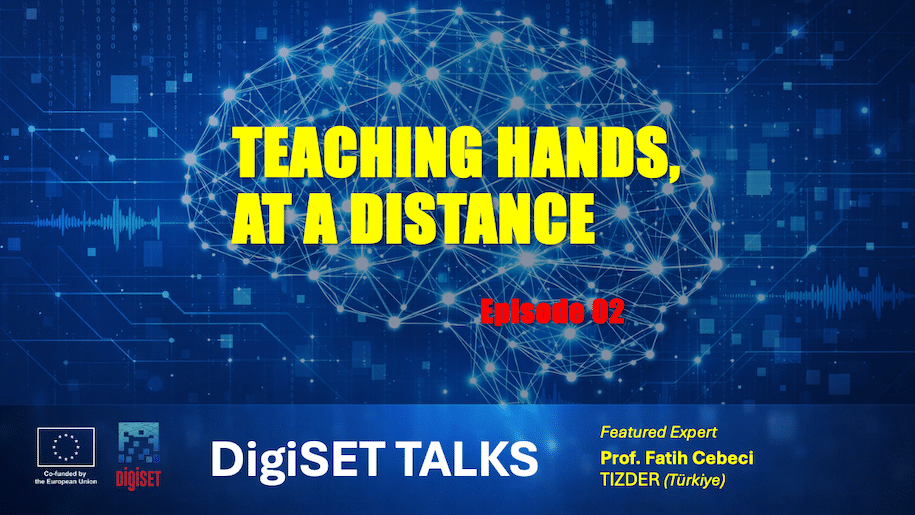
DigiSET Talks, the podcast of the DigiSET Erasmus+ Teacher Academy, is back with its second episode, Teaching hands, at a distance, now on YouTube and on the project website. It is curated by TIZDER, a Turkish education association, which invited Fatih Cebeci, a vocational and technical teacher at the Turkish Ministry of National Education, as its featured expert. The starting point will be familiar to anyone who teaches a trade: what becomes of practical training when it has to move from the workbench to a screen?
The episode opens in a mechatronics workshop, where students learn with their hands, and follows that learning as it moves online. It draws on a study by Cebeci of 153 mechatronics students at a vocational high school in an industrial zone near Istanbul, surveyed during the switch to distance learning. The result is counterintuitive. Neither the students’ study habits nor their academic track explained how keen they were to keep learning at a distance. The one factor that made a significant difference was the quality of the online teaching: how effective it was, and how well designed.
From there, the two hosts ask what good design actually means for a practical subject: material built on Richard Mayer’s principles of multimedia design, asynchronous videos that students can rewatch at their own pace, and simulators as an alternative when the workbench is out of reach. The conversation then widens to digital sustainability in education. For Cebeci, integrating technology is not enough on its own; it has to go hand in hand with integrating strategy, with a view of the system as a whole. And the teacher’s role keeps shifting, from teacher to guide, from guide to facilitator. Teaching remains a valuable profession, he argues, and those who adapt to change and keep learning sustainable will carry it forward.
Behind the series stands DigiSET, the Digitally Sustainable European Teacher Academy funded under the Erasmus+ programme, which brings together 16 partners across eight countries, coordinated by the University for Continuing Education Krems. The project supports teachers in developing a new competence profile, one that holds together digital ability, environmental awareness and the personal and social skills needed to teach in a changing world. It works through three tools, a community of practice, a massive open online course and a virtual simulation platform, along a path that moves teachers from learners to developers and, finally, to ambassadors of change.
One choice ties the form of the podcast to the themes of the project: the episodes are made with artificial intelligence, openly and deliberately. This is not a technical gimmick, it is part of the message. The method developed to produce them, from reading the source materials to generating the voices, will become part of the pool of experience available to the teachers of the Academy, who can reuse and adapt it for their own teaching. In this way the podcast is not simply a communication product, it becomes a method others can repeat, and it extends the project value well beyond its end date.
DigiSET Talks will run for the whole life of the project, with 30 episodes between 2026 and 2028. The series is produced by OpenCom, which leads the project communication, while overall scientific oversight rests with the University of Siena. Each episode is then curated by a different consortium partner, who invites an expert to provide its scientific content. This second episode is curated by TIZDER, with Fatih Cebeci as its featured expert. Future releases will follow the rhythm of the project, giving voice to the themes and research of its different partners.
The second episode is available on:
YouTube: https://www.youtube.com/watch?v=pXdKNPljXf0
Website: https://digisetproject.eu/podcast/
EPALE: https://epale.ec.europa.eu/it/resource-centre/content/digiset-talks-ep-2-teaching-hands-distance
DigiSET project, digisetproject.eu. Co-funded by the European Union. Views and opinions expressed are those of the author(s) only and do not necessarily reflect those of the European Union or the EACEA.