
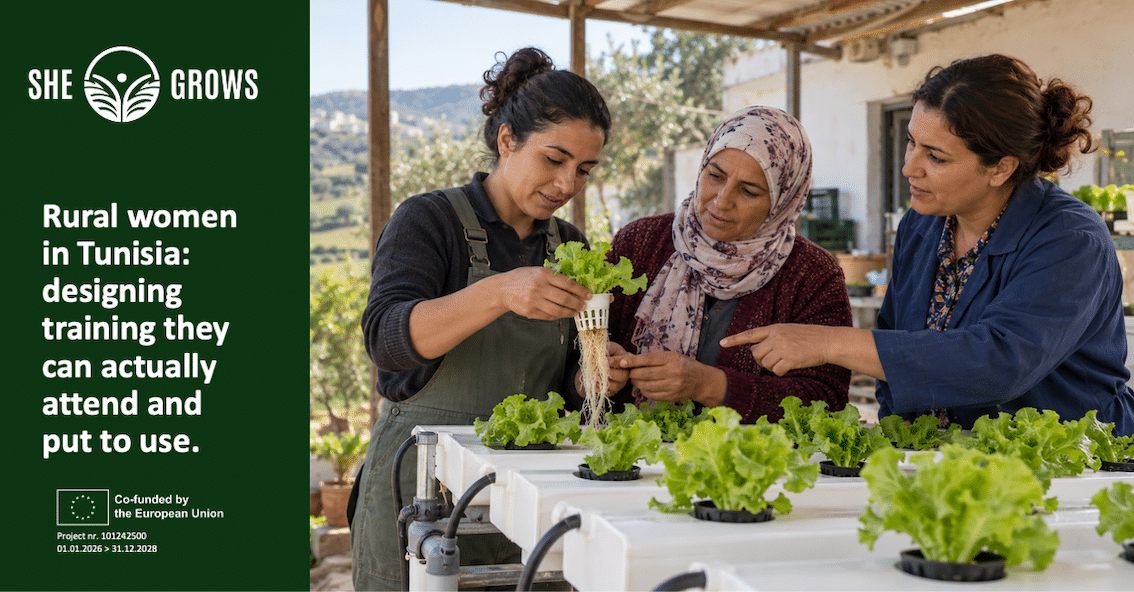
The Erasmus+ project SHE-GROWS drew on more than a thousand questionnaires, 37 interviews and two focus groups in the Tunisian governorates of Béja and Jendouba. There are lessons here for anyone who trains adults in rural areas.
For many women in the countryside of north-western Tunisia, a training course can be free, open to them and well run, and still be out of reach. Getting there means paying for transport, spending a long time away from home and finding someone to look after the children. That is one of the findings of research carried out by SHE-GROWS, a European project, before it designed its own courses. As one of the institutional representatives consulted put it, the problem is not just a lack of opportunities but how hard it is to reach the ones that already exist.
SHE-GROWS (Sustainable Hydroponic Education for Growing Rural Opportunities), co-funded by the European Union under the Erasmus+ programme, trains people from rural north-western Tunisia in hydroponic farming (growing crops without soil, in nutrient-enriched water) and sustainable entrepreneurship. To understand who will attend the courses and what might stop them, the consortium produced a report, completed in September 2026, that maps barriers and opportunities with gender differences in mind. It draws on a questionnaire with more than a thousand responses, 27 in-depth interviews with rural women and agricultural practitioners, 10 key-informant interviews, two focus groups held separately with women and with men, and a round of local consultations.
Start with the road. Among those who answered the questionnaire, more than half of the women list distance from training centres or the cost of transport among the obstacles faced by themselves or by others in their community. Among the men, the figure is just over one in five. The cost of courses and materials is flagged by three women in ten, against one man in ten. The interviews point to a knock-on effect: the longer the journey, the longer someone else has to look after the house and the children.
The report suggests practical answers: sessions at women’s group premises or on nearby farms, timetables that fit around the farming seasons and the school year, and help with transport where needed. These need to be planned in from the start rather than bolted on once attendance starts to slip. Digital tools can help, but they are no substitute for hands-on practice in person, not least because more than a third of respondents have no digital device.
And who will be in the room? Among questionnaire respondents, only one in five has any previous vocational or non-formal training, and almost three in four had never heard of hydroponics (among women, just over half). Yet it would be a mistake to treat participants as beginners. The interviews describe women who grow crops, raise livestock, process produce, manage irrigation and sell what they make. The gap, the authors note, is in one particular technology, not in farming. The course should start from what they already know.
Almost eight in ten say they are at least moderately interested in training in hydroponics. But interest is not the same as willingness to invest, the report warns. It proposes going step by step: first understanding the technology and seeing it work, then trying it out, and only then weighing up whether it makes sense for them and thinking about costs and markets. Participants should know beforehand how much routine work a system needs, so that the opportunity does not turn into yet another unpaid burden. The authors also suggest building setbacks into the course: a demonstration unit that always works perfectly risks creating enthusiasm without teaching anyone what to do when things go wrong.
On gender, counting the women in the room is not enough. According to the report, participants should install, check and maintain the systems themselves rather than watch someone else do it. That way, technical authority comes from practice instead of being tacitly handed to others. The report also asks trainers to make sure everyone actually uses the equipment, and to know where to refer participants for things outside a trainer’s remit, such as credit or access to markets.
One criticism of past training comes up in the interviews: one-off courses, with no equipment to practise on and nobody to turn to when something went wrong. So the report calls for technical support that carries on after the sessions end, so that the course does not stop at the certificate. Assessment should focus on what people can do rather than what they can remember, using practical tests and oral explanations where literacy levels vary. A credible certificate also matters outside the classroom: some women say that without documented skills they struggle to get credit or access institutional programmes.
The women involved in the research, the authors note, appear to be disproportionately those already connected to markets, digital tools and associations. Relying solely on organised groups therefore risks reaching those who already have most access to opportunities. SHE-GROWS plans to train 60 people, at least half of them women. The report treats that as a minimum, which on its own does not show that the training is inclusive. Enrolling someone says nothing about whether they will attend, learn to do the work or have the means to do it afterwards.
The consortium will build on these findings over the coming months. Coordinated by EFA El Soto (Spain), the project brings together OpenCom (Italy), Libverda (Czech Republic) and three Tunisian organisations: ELEMTIEZ, Grow It Yourself (GIY) and the Tunisian Union of Agriculture and Fisheries (UTAP). The report will guide the curriculum (to be tested with focus groups in rural communities), the preparation of trainers and the pilot course, which is expected to lead to the creation of a cooperative.
The report itself urges caution in reading these results. The questionnaire is descriptive, based on self-reported answers and not representative of the rural population of the two governorates. And six responses in ten came from men. The women’s focus group had six participants, and many of the women interviewed already belong to groups and associations. That is why the authors recommend listening more closely to women at the start of the pilot phase.
The report was written by Wafa Chebbi (ELEMTIEZ) and Erina Guraziu (OpenCom). OpenCom coordinates the project’s needs analysis; the fieldwork was led by ELEMTIEZ, with GIY mapping local stakeholders and UTAP providing access to farmers and communities. The full report, in English, is available on Zenodo under a Creative Commons licence: https://doi.org/10.5281/zenodo.23059496.
Project updates are at www.shegrowsproject.eu.
The authors close with a principle: adapt the technology and the support to women’s different circumstances, rather than asking women to adapt to a path decided in advance. Applied to those free but unreachable courses, it means no longer asking why women do not turn up and asking instead what has to change for training to reach them.
This article is published as part of the SHE-GROWS project (Sustainable Hydroponic Education for Growing Rural Opportunities), co-funded by the European Union under the Erasmus+ programme and coordinated by EFA El Soto, Grant Agreement no. 101242500. Funded by the European Union. Views and opinions expressed are however those of the author(s) only and do not necessarily reflect those of the European Union or the European Education and Culture Executive Agency (EACEA). Neither the European Union nor the granting authority can be held responsible for them.
Images generated using artificial intelligence (AI). The people shown are not real.