
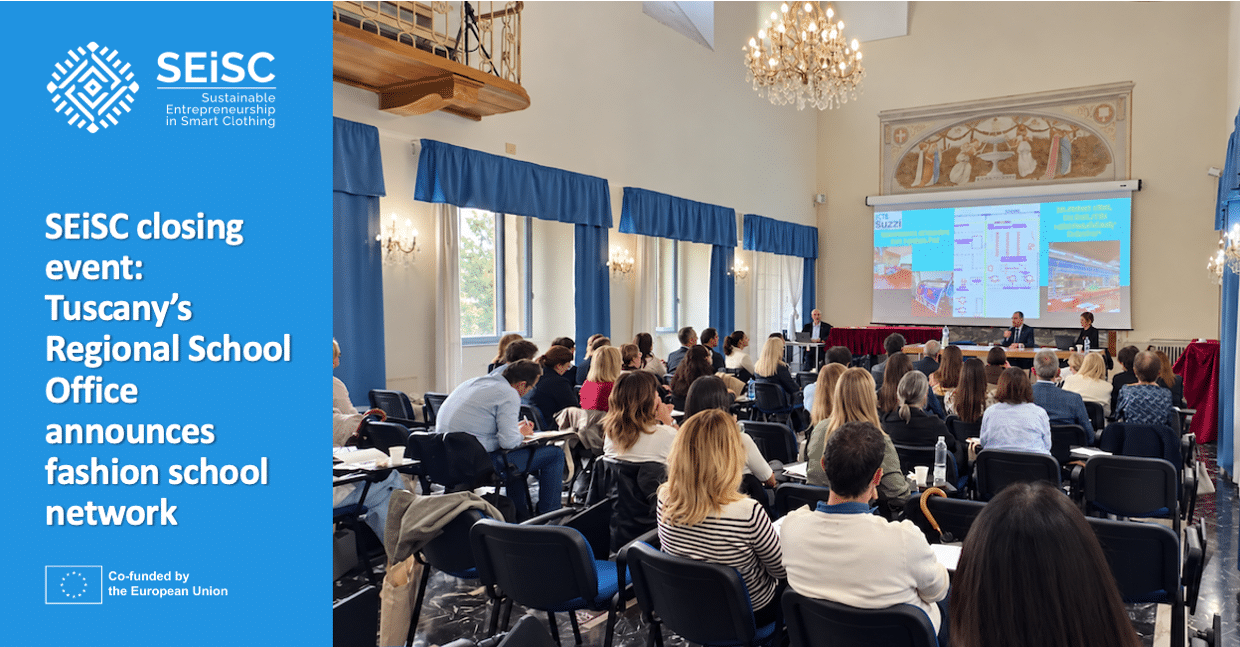
Arezzo hosts the Italian closing event of the Erasmus+ project SEiSC, where Director General Luciano Tagliaferri announces a new network of schools across the fashion supply chain
Tuscany’s Regional School Office (Ufficio Scolastico Regionale per la Toscana) intends to bring together the region’s 18 schools working on fashion, sustainability and entrepreneurship in a single network, which will then seek agreements with trade associations, ITS Academies and fashion businesses. Director General Luciano Tagliaferri announced the plan on Thursday 8 October as he closed the Italian final event of SEiSC (Sustainable Entrepreneurship in Smart Clothing) at the Convitto Nazionale “Vittorio Emanuele II” in Arezzo. The Regional School Office is a partner in the Erasmus+ project, alongside the Arezzo-based research centre OpenCom and the Cellini-Tornabuoni institute in Florence.
“Schools become a genuine nursery. For what? To help our Made in Italy grow,” Tagliaferri said, pointing to the work already under way with schools in the “4+2” pathway, which pairs four years of technical or vocational secondary education with two years at an ITS Academy, Italy’s higher technical institutes. He had set the tone in his opening remarks: “When there’s an event, something has to happen afterwards.” The audience included heads of around ten Tuscan schools, the University of Siena, the national education research institute INDIRE, ITS MITA Academy, trade associations and the Kering Group’s Accademia per le Eccellenze.
The starting point was a school system struggling to keep pace. Mario Giampaolo, associate professor at the University of Siena, presented research carried out for the European project DigiSET among 229 Italian teachers. Their interest in sustainability is very high, but they lack practical examples of how to bring it into the classroom through technology; assessment driven by artificial intelligence is the area they trust least; and lack of time is the main barrier to training. Roberto Curtolo, a senior manager at the Regional School Office, turned the question round and asked whether schools themselves are sustainable: “Before we ask how powerful the tool is, let’s ask what cognitive work is left to the person.” On funded projects, he added: “If nothing remains, we have produced activities without generating development.” Francesca Storai of INDIRE, discussing the 4+2 pathway, put it more bluntly still: “Either you change everything or you change nothing.”
On the industry side, Antonella Vitiello, general manager of ITS MITA Academy, described sustainability moving from something companies talk about to an operational capability, driven by new EU rules on ecodesign, producer responsibility, unsold goods and the digital product passport. “Circularity doesn’t begin at the bin; it begins at the design stage,” she said. Cristina Bocali, Global Learning Director at Gucci, cited research suggesting that Italy’s luxury sector will need around 75,000 artisans by 2035, “and, essentially, we are not ready”. The first lesson Gucci will offer schools in the Accademia per le Eccellenze network will be on sustainability. Paolo Pernici, president of CNA Federmoda Toscana, asked schools for skills businesses do not yet have: “I’d like contact with schools and students who bring me what I don’t know, because what I do know, I already have.” Giovanni Basagni, speaking for Confindustria Toscana Sud, noted that Arezzo’s fashion sector counts around 750 companies and 7,500 workers, and urged trade associations to present a more united front to schools.
SEiSC itself showed what can reach the classroom. Teachers at Cellini-Tornabuoni, trained in adaptive teaching and some of them in Helsinki alongside European colleagues, have begun piloting Agora Lake, the simulation platform developed by OpenCom, with their classes; their students won the project’s video contest with a smart clothing idea. Erina Guraziu, president of OpenCom, explained that students work on the platform in teams, tackling a complex scenario built around a large sustainable sporting event, while the path adapts to each team’s mistakes. Artificial intelligence was used to build the scenarios; in the classroom, the teacher stays in charge. From November, schools will be able to use the platform free of charge, together with a teacher’s guide and the project’s online course. “We’re talking about Erasmus, about public money, so something has to remain that lasts,” Guraziu said.
SEiSC is coordinated by the Finnish vocational education provider Lounais-Hämeen koulutuskuntayhtymä and brings together nine partners from six countries. It ends on 31 October. For Tagliaferri, the day marks a beginning: “Today, from Arezzo, let a seed go out that can truly take root in Tuscany and bring schools into line with the real needs of our businesses.”