
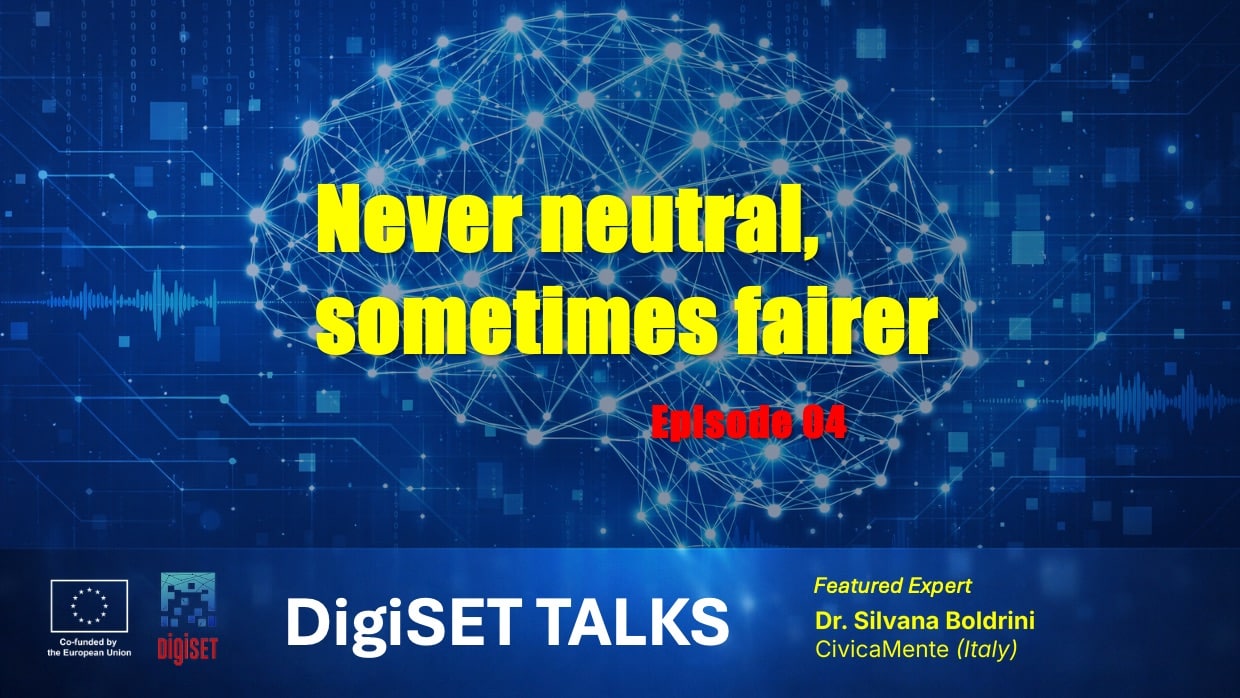
DigiSET Talks, the podcast of the DigiSET Erasmus+ Teacher Academy, reaches its fourth episode, Never neutral, sometimes fairer, now on YouTube and on the project website. It is curated by CivicaMente, an Italian benefit company working in digital education, which invited Silvana Boldrini, an education specialist in learning design and educational technology, as its featured expert. Its subject is gender bias in the AI tools used in schools: not the obvious kind, which many models have learnt to avoid, but the small, everyday kind that slips past even attentive teachers.
The episode opens with an experiment anyone can repeat. Ask an AI tool the same question twice about a fifteen-year-old who is good at maths, first describing a boy, then a girl. The answers are almost the same. Almost: a word of caution here, a bolder example there. For Boldrini, that is exactly the point. AI arrives in school quietly, often through the students themselves, in tools that look neutral. Bias rarely shows up any more as a crude stereotype. It works as a small decision repeated every day, about difficulty, examples, feedback and pathways, and over time it shapes a student’s confidence and how they picture their future.
Research helps explain where it comes from. A study of automated marking found that models trained on a balanced mix of boys’ and girls’ answers showed no significant bias, while models trained on one-sided data widened existing gaps. A review of fairness in educational AI describes a careers platform that steered girls towards nursing and teaching and boys towards STEM. Teachers are not asked to become technicians. They are asked to read every AI output as a proposal to question, and to ask three things before sharing it with students: what am I delegating, what assumptions is the tool bringing in, and what check have I applied? Boldrini’s message is not a comfortable one, but it leaves room for hope: AI is never neutral, yet it can become fairer in the hands of prepared teachers who ask good questions.
Behind the series stands DigiSET, the Digitally Sustainable European Teacher Academy funded under the Erasmus+ programme, which brings together 16 partners across eight countries, coordinated by the University for Continuing Education Krems. The project supports teachers in developing a new competence profile, one that holds together digital ability, environmental awareness and the personal and social skills needed to teach in a changing world. It works through three tools, a community of practice, a massive open online course and a virtual simulation platform, along a path that moves teachers from learners to developers and, finally, to ambassadors of change.
One choice ties the form of the podcast to the themes of the project: the episodes are made with artificial intelligence, openly and deliberately. In this episode the choice carries extra weight. An episode that asks teachers to question AI was itself made with AI, and human judgement stays part of the method, from choosing the sources to the final review. The method developed to produce the series will become part of the pool of experience available to the Academy’s teachers, who can reuse and adapt it for their own teaching, extending the project’s value well beyond its end date.
The series is produced by OpenCom, which leads the project communication, while overall scientific oversight rests with the University of Siena. Each episode is then curated by a different consortium partner, who invites an expert to provide its scientific content. This fourth episode is curated by CivicaMente, with Silvana Boldrini as its featured expert. Future releases will follow the rhythm of the project, giving voice to the themes and research of its different partners.
The fourth episode is available on:
Website: https://digisetproject.eu/podcast/
DigiSET project, digisetproject.eu. Co-funded by the European Union. Views and opinions expressed are those of the author(s) only and do not necessarily reflect those of the European Union or the EACEA.