
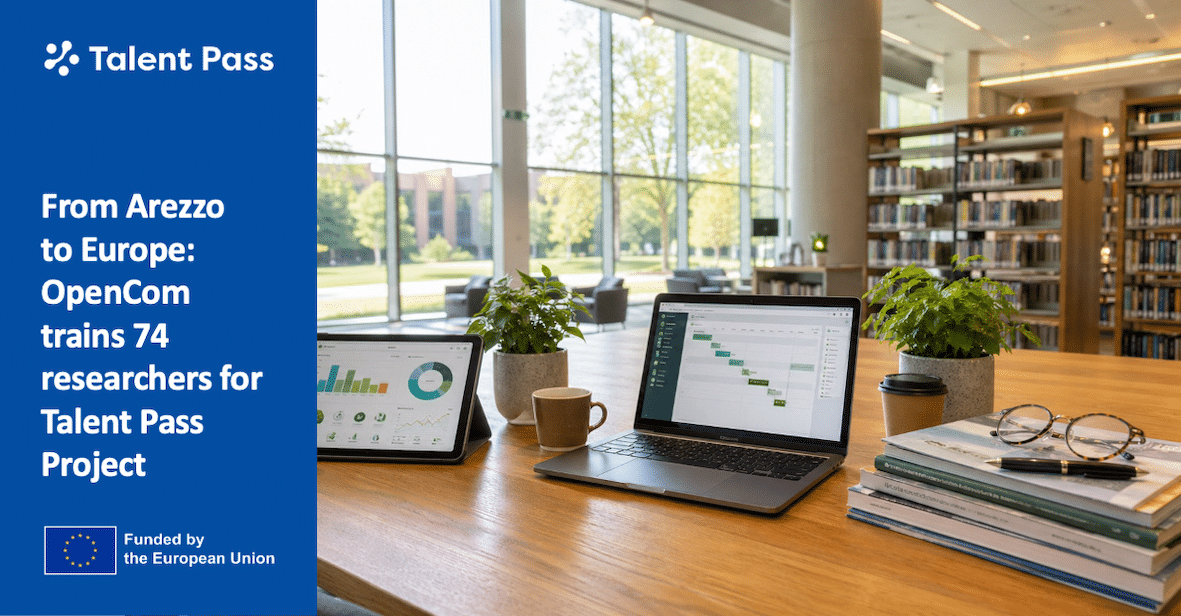
Seventy-four researchers from five countries are working on research ethics, artificial intelligence, EU project management and data analysis for sustainability. These are the first courses delivered by OpenCom as part of the Horizon Europe project Talent Pass, running between April and May 2026.
There is a contradiction that most European researchers know well: you can be outstanding in your scientific field and still struggle with a Grant Agreement, a data management plan or a sustainability metrics dashboard. These are transversal competences that no doctoral programme teaches, yet EU-funded projects demand them from day one. This is precisely the gap that the Talent Pass training programme sets out to address.
The project, fully funded by Horizon Europe and coordinated by the Institutul de Chimie Macromoleculară Petru Poni (ICMPP) in Iași, brings together ten partners from seven countries with a clear goal: to train 106 talents over four years, narrowing the skills gap between Europe’s so-called “widening” countries and those with more established research ecosystems. The thematic focus is circular economy; the method combines targeted training with cross-sectoral secondments between academia and industry.
OpenCom, the Italian partner in the consortium, leads the development of the trainers’ community (Task 1.2 within the Trainings Work Package). Its first training cycle, structured around three online modules, brings together the initial cohort of 74 participants: researchers, technical and administrative staff from ICMPP and ECOIND (Romania), NIC (Slovenia), IST-ID (Portugal) and CRC (Romania).
The first module, delivered by Erina Guraziu, president of OpenCom and lecturer in Digital Transformation and Project Management at IUL University in Florence, tackles transversal topics in research management. The two days take a distinctly hands-on approach: day one covers ethics, gender equality and data management under FAIR principles and GDPR, with participants running ethical review simulations and gender audits on real EU projects. Day two shifts to the critical use of artificial intelligence in research and project management. Participants draft proposal sections using AI tools, peer-review the outputs and then deliberately try to break the AI to expose its limitations. The module is explicitly aligned with two European competence frameworks published in 2025: ResearchComp and RM Comp.
The second module, led by Ivan Brkić, lecturer and Director of Projects at ALFA BK University in Belgrade, with more than 19 years of experience in EU-funded projects, takes participants into the practicalities of post-award management. From Grant Agreement preparation to financial management, monitoring and audits to risk management, intellectual property rights to PRAG rules: the course covers the full lifecycle of a European project once the contract is signed. It closes with an introduction to Agile approaches applied to EU project management.
The third module, delivered by Juraj Dončević, a postdoctoral researcher at the University of Zagreb, shifts the focus to data. Participants move from the fundamentals (relational databases, data warehousing, star schemas) through to building their own interactive dashboards in Metabase. Every exercise is rooted in circular economy: the datasets involve sustainability metrics, ecodesign and environmental analysis. By the end of the course, each participant has a working dashboard they have built themselves.
Three modules, three trainers with very different profiles, one common thread: delivering practical skills to researchers in widening countries, where the issue is often not scientific quality but access to tools and methodologies that are taken for granted elsewhere.
The next stages of the project will expand the training offer and launch cross-sectoral secondments across the consortium.
For more information: www.talentpass-project.eu
The Talent Pass project (GA 101217448) is funded by the European Union’s Horizon Europe programme under call HORIZON-WIDERA-2024-TALENTS-03. Views and opinions expressed are however those of the authors only and do not necessarily reflect those of the European Union. Neither the European Union nor the granting authority can be held responsible for them.