
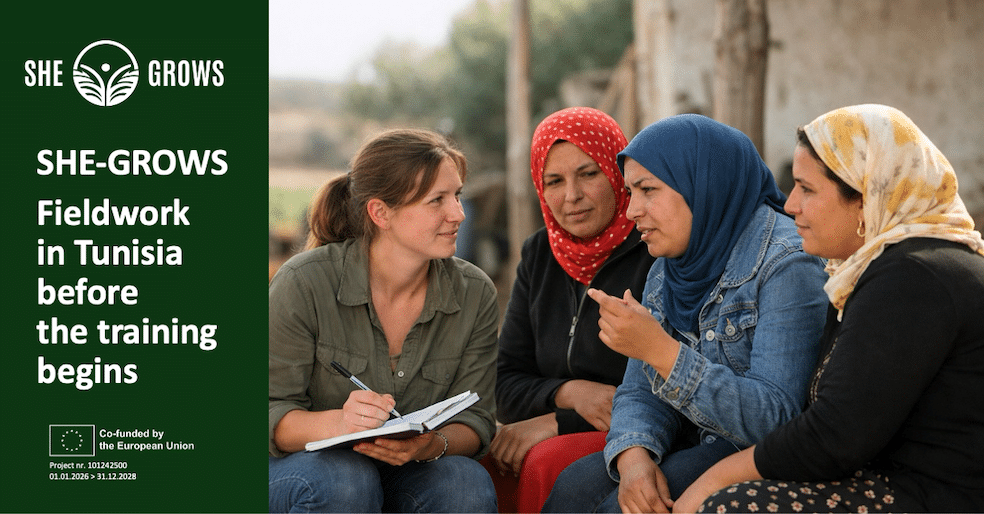
Before designing any training for rural women in Tunisia, the SHE-GROWS project set itself an uncomfortable question: do we actually know what is holding these women back? The European consortium has developed a research framework that will guide fieldwork in the regions of Béja and Jendouba throughout 2026.
Designing a curriculum before understanding the context is one of the most common mistakes in rural development initiatives. SHE-GROWS, a three-year project co-funded by the European Union under the Erasmus+ Capacity Building for VET programme, has taken a different approach. Before drafting a single training module on hydroponics or cooperative entrepreneurship, the consortium invested the project’s opening phase in rigorous, structured, and participatory research.
The outcome is the Research Design Framework, developed by OpenCom i.s.s.c. as coordinator of the research activities and shared across the full partnership. The document is not a procedural box-tick: it is the conceptual and operational map that will guide data collection in the field during spring and summer 2026.
The overarching research question is deliberately broad: what technical, socio-economic, cultural, and institutional barriers and enablers shape rural women’s capacity to adopt hydroponic farming in the governorates of Béja and Jendouba, and what are the implications for vocational training design? The breadth is intentional. It acknowledges the complexity of the context rather than flattening it.
The framework is built around five interconnected analytical dimensions. The first addresses socio-economic conditions and vulnerabilities: income, land access, employment, credit, food security. The second examines the cultural norms and gender dynamics that shape agricultural decision-making, the system of values, attitudes, and relationships that determines how much agency women have over their own productive activity. The third analyses skill gaps and the practical barriers to accessing vocational training, which are not only geographical or financial, but often tied to schedules incompatible with domestic responsibilities, lack of childcare, or distrust of non-traditional training pathways. The fourth dimension documents existing farming practices, water management systems, and climate adaptation strategies, in order to understand where and how hydroponics, which can reduce water consumption by up to 90 per cent compared to conventional agriculture, might credibly fit in. The fifth dimension, which cuts across all the others, maps the local cooperative and institutional landscape, essential groundwork for the agricultural cooperative the project aims to establish in its final phase.
The methodology is mixed. An ambitious quantitative survey targeting 800 to 1,000 respondents across both governorates, administered in Arabic and French by the Tunisian partners (ELEMTIEZ, UTAP and GIY), will be combined with a qualitative strand comprising in-depth interviews, separate focus groups with rural women and community leaders, and case studies on local farming practices. The ethnographic orientation is deliberate: it prioritises contextual understanding and participants’ own perspectives over statistical data alone. An ethical protocol, integral to the framework, ensures informed consent, anonymity, and cultural sensitivity throughout all data collection activities.
The SHE-GROWS consortium brings together six organisations: EFA El Soto (Spain, coordinator), OpenCom i.s.s.c. (Italy, responsible for communication and research coordination), Libverda (Czech Republic), and ELEMTIEZ, UTAP and GIY (Tunisia). The project runs for 36 months.
All research findings will feed into the Gender-Responsive Mapping Report, due in August 2026, which will serve as the evidence base for curriculum design, the Train-the-Trainers programme, and the cooperative model to be implemented in subsequent project phases. It is one of those documents that, if done well, is not simply read: it is used.
SHE-GROWS (Sustainable Hydroponic Education for Growing Rural Opportunities) is co-funded by the European Union under the Erasmus+ Capacity Building for VET programme.
Project Website: https://shegrowsproject.eu/