
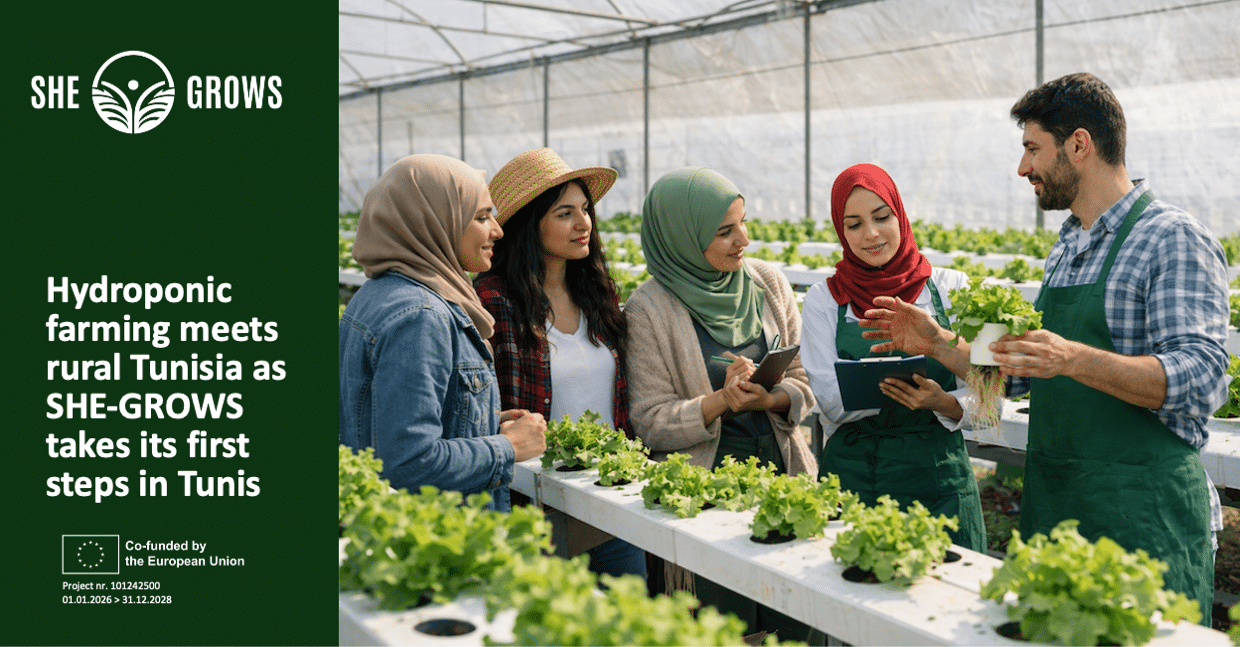
How do you farm where water is scarce, and soil is degrading? And how do you turn technical skills into real opportunities for rural women with limited access to the job market? These questions drive SHE-GROWS, the Erasmus+ project that took its first operational steps at a kick-off meeting in Tunis from 10 to 12 February 2026, hosted by UTAP.
In the Béja and Jendouba regions of north-western Tunisia, traditional agriculture faces mounting pressure. Seasons grow unpredictable, water tables drop, and yields decline. Farmers must produce more with fewer resources. Women often bear the heaviest burden, excluded from training, skilled employment and economic decision-making.
Hydroponics offers a different path. Soil-free cultivation using nutrient solutions cuts water consumption by up to 90 per cent, removes dependence on soil quality, and enables year-round production in limited spaces. The technology is not new, but its application in rural North Africa remains limited. Skills are lacking, training pathways are scarce, and awareness that alternatives exist is often absent.
This is where SHE-GROWS steps in. Over three days in Tunis, the six consortium partners, from Spain, Italy, Czechia and Tunisia, mapped out the next three years of work. On the first day, following a welcome from UTAP’s Moez Ben Zaghden, each organisation presented its background and expertise. Technical sessions led by Juan José Nuevo Sanchez from EFA El Soto and Ivana Vávrová from Libverda drew particular interest, showcasing hydroponic practices already tested in Spain and Czechia, two distinct approaches that will feed into the training curriculum for Tunisian beneficiaries.
Yet technical training alone is not enough. The project pairs hydroponic modules with a parallel track on cooperative entrepreneurship: how to set up an agricultural cooperative, how to manage it, how to access local markets. The goal is not to train employees, but to give sixty women the tools to launch sustainable, self-run businesses.
Day two tackled this challenge head-on. A brainstorming session on Work Package 2, coordinated by OpenCom, defined the research methodology for fieldwork: questionnaires, interviews and stakeholder engagement in local communities. Partners view this step as essential to avoid imposing solutions designed elsewhere.
The final morning looked ahead. The next transnational meeting will take place in Granada, Spain, where partners will review progress from the preparatory phase. Meanwhile, fieldwork in Tunisia has already begun.
For project updates: www.shegrowsproject.eu
SHE-GROWS – Sustainable Hydroponic Education for Growing Rural Opportunities is an Erasmus+ Capacity Building project in the field of Vocational Education and Training (VET), co-funded by the European Union.