
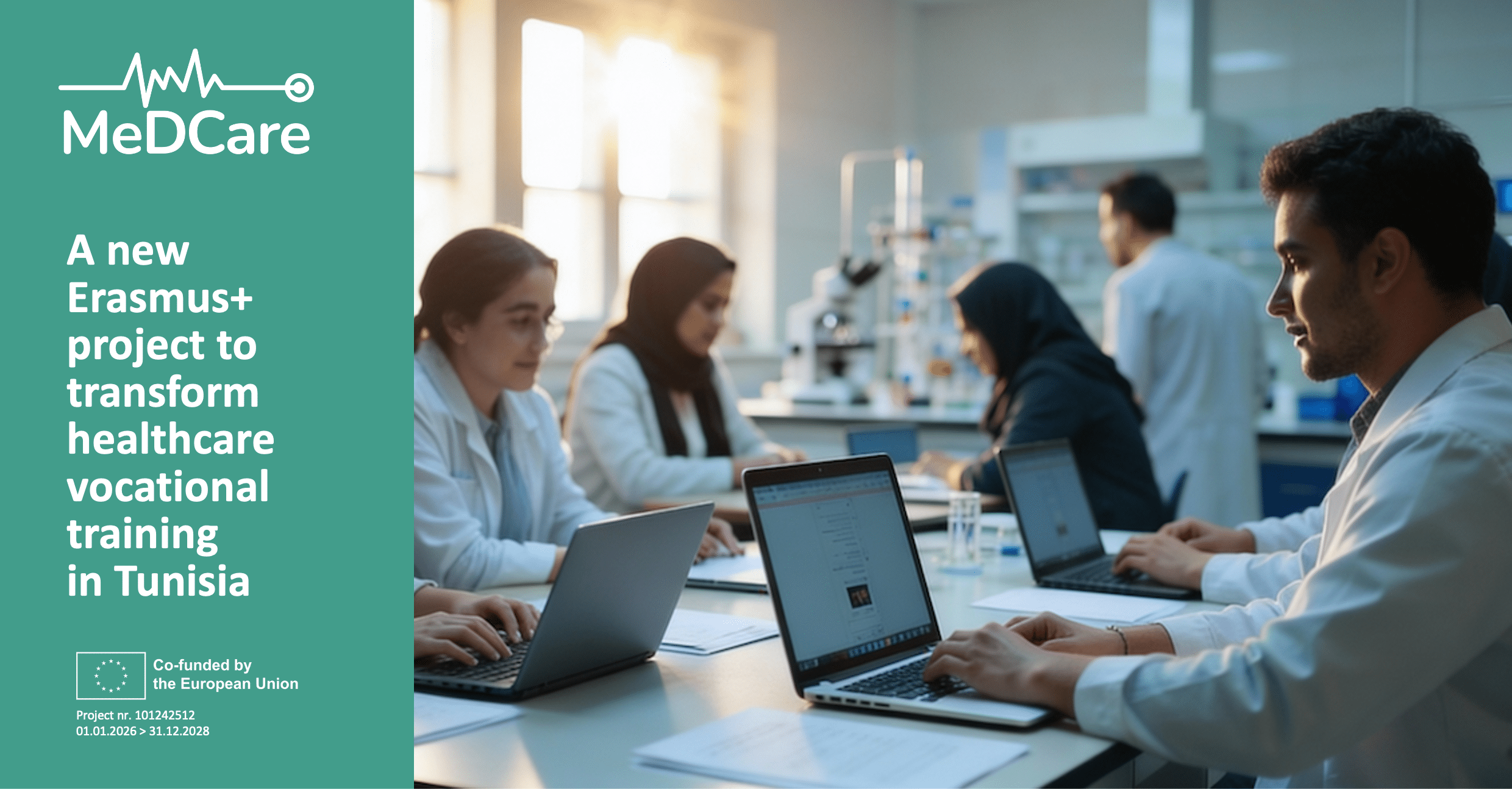
The kick-off meeting of MeDCare, a three-year project funded by the Erasmus+ programme to modernise vocational training in healthcare and biomedical technology, took place in Jendouba, Tunisia, from 16 to 18 February. Partners from Italy, Spain and Tunisia gathered for the first time to finalise the work plan, but the meeting also provided an opportunity for in-depth discussion on the context in which the project operates.
The choice of Jendouba as the venue carries significance. The city lies in northwest Tunisia, one of the country’s most economically vulnerable regions, where the need to create training and employment opportunities for young people is particularly pressing. The meeting was hosted by Elemtiez, a Tunisian project partner with over 25 years of experience in vocational education and a strong track record in building training programmes aligned with labour market needs.
Over three days of intensive work, the exchange between European and Tunisian partners brought the international dimension of the challenge into sharp focus. The migration of healthcare professionals is not merely a Tunisian issue: it is a global dynamic that follows a simple logic. Europe has faced a structural shortage of healthcare workers for years, creating a natural pull towards countries offering better conditions, clearer career paths, access to advanced training and state-of-the-art facilities. Tunisia, like many Mediterranean and African countries, finds itself on the other side of this flow.
Data shared during the meeting confirmed the scale of the phenomenon. According to the Institut Tunisien des Études Stratégiques, working conditions are the primary reason for emigration among 75.8 per cent of Tunisian healthcare workers, followed by inadequate pay (70 per cent) and job insecurity (62.3 per cent). Lack of access to advanced specialist training and research projects provides a further incentive to leave. This is not flight, but rational choice: those who emigrate are seeking opportunities that the local system struggles to provide. The result, however, is a vicious cycle in which the health system loses expertise, training investments are wasted and service quality suffers.
From this shared analysis emerged the vision that will guide the work ahead. MeDCare does not aim to block mobility, which remains both a value and a right. The goal is to create attractive alternatives: a European-recognised professional pathway, with up-to-date skills and real prospects, can make staying as valid a choice as leaving. The dual-recognition diploma for Medical Technology and Digital Health Care Technicians, valid in both Tunisia and Italy, responds to a growing demand for digital skills in healthcare, a need shared by health systems worldwide.
Beyond strategic discussion, the meeting allowed partners to define the project’s governance structure, quality assurance and monitoring mechanisms, and to plan the first operational phase in detail. In the coming months, the consortium will launch comprehensive research into the competences required by Tunisia’s healthcare sector and the barriers hindering innovation in vocational training. This will involve focus groups with digital health experts, alongside consultations with healthcare facilities, training providers and local authorities. The findings will feed into a report that will guide the development of the new training curriculum.
The meeting also provided an opportunity to present the communication and dissemination strategy, which is essential to ensure project results reach the widest possible audience and can be replicated in other contexts.
The consortium’s next appointment will be in Valencia, Spain, where partners will review progress and prepare the curriculum development phase.
For updates on project activities: www.medcareproject.eu
Co-funded by the European Union. Views and opinions expressed are however those of the author(s) only and do not necessarily reflect those of the European Union. Neither the European Union nor the granting authority can be held responsible for them.