
A survey of 1,378 teachers and student teachers in eight countries by the Erasmus+ project DigiSET
Teachers don’t need convincing that the climate crisis matters to their pupils, or that artificial intelligence is now part of young people’s lives. They know. The question they carry into the classroom is different: what, in practice, to do about all this in a single lesson, with a full class in front of them and a syllabus to get through.
Many teachers will recognise this question, and it now comes with figures attached. In May and June 2026, DigiSET, a project co-funded by the European Union under the Erasmus+ Teacher Academies programme (project No. 101249272), asked teachers and student teachers in eight European countries to assess their own skills. The survey covered four areas: digital teaching, artificial intelligence, education for sustainable development and open educational resources (teaching materials that anyone is free to use, adapt and share). 1,854 people started the questionnaire, and 1,378 responses were included in the analysis, well above the 800 the project had aimed for. The results, published at the end of September, bring that question into sharper focus.
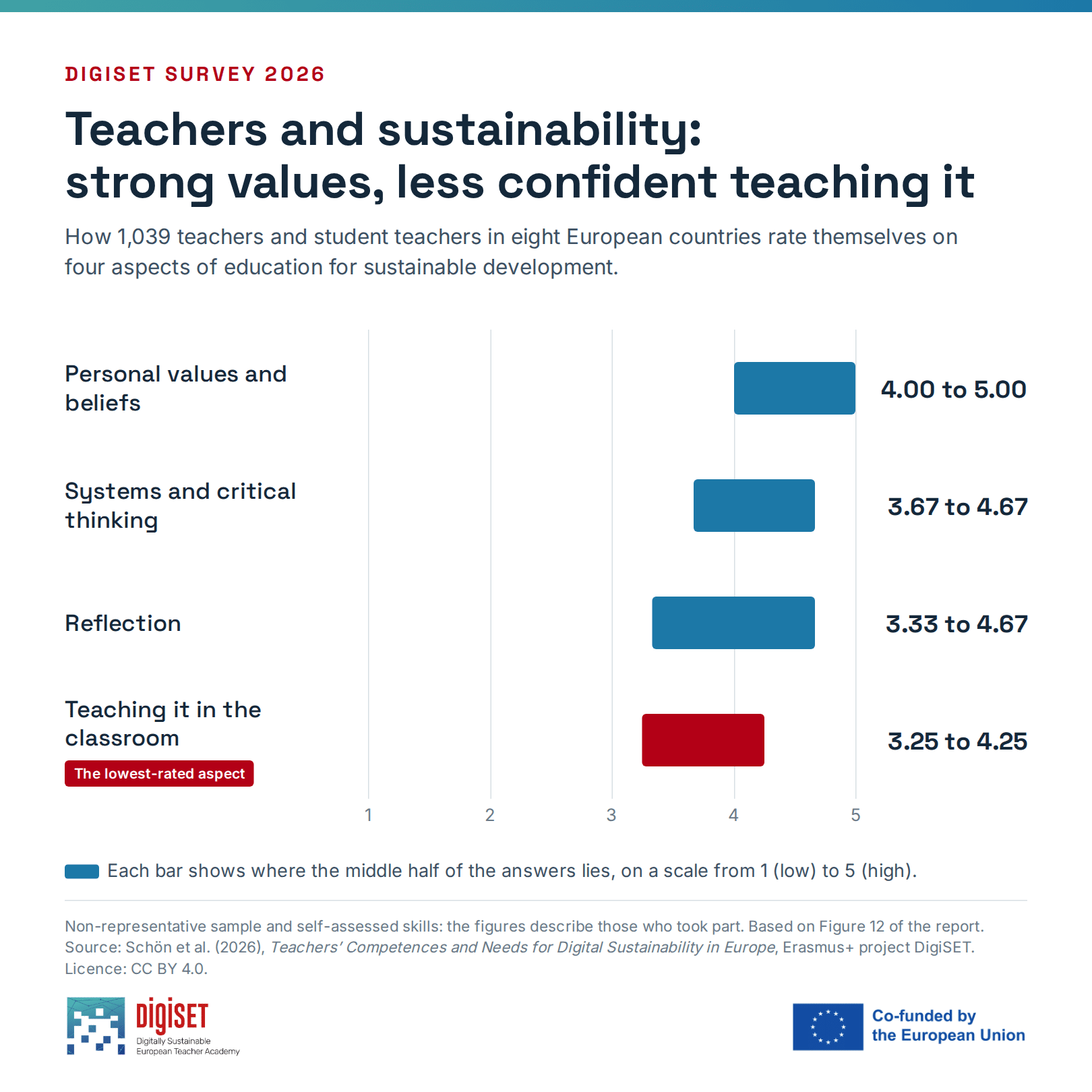 The most striking finding isn’t what teachers don’t know. It is about the distance between what they believe and what they say they manage to do in the classroom. Sustainability is where they rate themselves highest, especially when it comes to their personal values. Yet the weakest point in that same area is the ability to turn those values into a lesson. The pattern repeats itself with digital tools. Finding and adapting material online comes easily; using the same tools to monitor pupils’ progress or give effective feedback does not.
The authors have a name for this: an ‘implementation gap’. Their interpretation focuses on in-service training, which, they suggest, often raises awareness but far less often leaves teachers with tools they can take into the classroom. The problem, in other words, would seem to lie not in teachers’ willingness but in a shortage of concrete, ready-to-use teaching models.
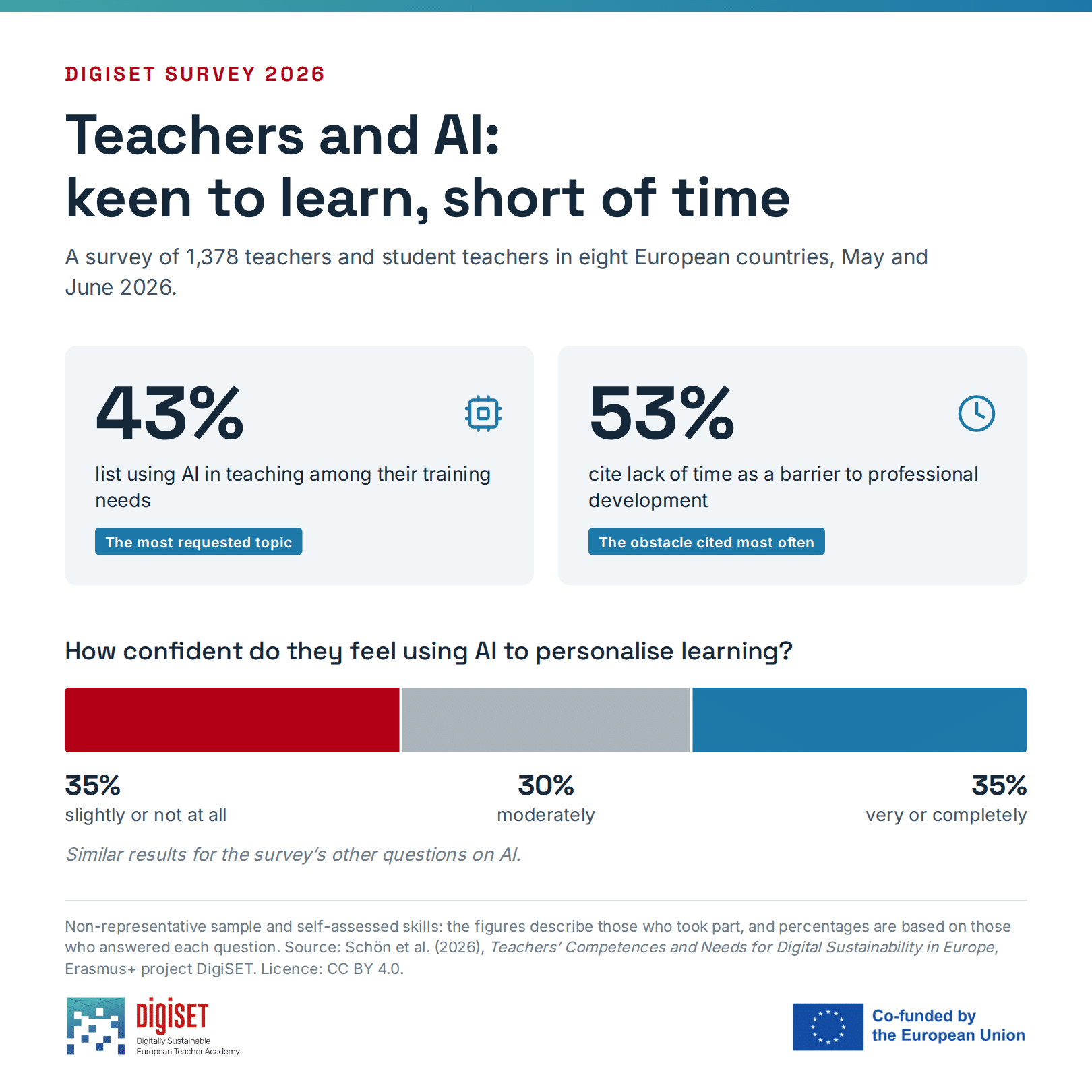
On artificial intelligence the picture changes and becomes more divided. This is where teachers feel least prepared, and where the largest proportion say they are starting from scratch. It is also where they most want training: more than four in ten list using AI in teaching among their training needs, more than for any other topic. But here the average tells us little. Asked how confident they feel using AI to personalise learning, about a third say they are very or completely confident, another third only slightly or not at all, and the rest fall somewhere in between. Rather than a teaching workforce uniformly lagging, the authors see groups with very different starting points, from those already using these tools to those still taking their first steps. A one-size-fits-all course, they warn, would risk serving none of them well.
 Another finding directly affects the project. Feeling confident about sustainability does not necessarily mean feeling ready for AI, and vice versa: the two skill sets overlap only slightly. Earlier this year, DigiSET’s national reports described school policy on the two as parallel tracks that never meet. Something similar now is emerging from the participants’ answers. If further research confirms this, the authors note, it would argue for training in the two areas in parallel rather than one after the other.
Then there is time. More than half cite lack of time as a barrier to professional development, making it the most commonly mentioned obstacle. Some way behind come the lack of available courses and the lack of suitable materials, each cited by about a third, followed by poor institutional support. None of this comes as a surprise, the authors point out: TALIS, the OECD’s international survey of teachers, tells a similar story. Precisely for that reason, though, their conclusions reach beyond the project. If professional development continues to rely on teachers’ voluntary, unpaid commitment, they write, it is unlikely to reach many teachers. Hence their call for EU member states to consider protected time in the school calendar, payment for training done outside working hours and short formats that fit into the working day.
For DigiSET, these answers are a starting point. The project brings together 16 organisations from eight countries, coordinated by the University for Continuing Education Krems in Austria. Its aim is to train and certify 700 teachers by 2028 based on a competence profile that combines digital skills, AI, sustainability, and inclusion. From the survey, the authors draw lessons for shaping both the profile and the training. Fewer sessions on why, and more tools for how: lesson plans, open materials that teachers can adapt to their own classes, ready-made prompts for AI tools. A pathway with several points of entry, so that someone strong on sustainability but new to AI can start the two strands at different levels. And case studies showing how other teachers have closed the gap between values and practice.
These pointers need careful handling, and the authors are the first to say so. The questionnaire combines scales already used in international research with questions developed by the project. However, it was circulated through the partners’ own networks in Austria, Bulgaria, Ireland, Italy, Norway, Romania, Spain and Türkiye, and respondents assessed their own skills. The figures therefore describe those who took part, not Europe’s teachers. That is the spirit in which we will use them.
Researchers from Graz University of Technology (which led the data analysis), the University of Siena, OpenCom, Technological University Dublin and the University for Continuing Education Krems wrote the report. The next step is to set its findings alongside those of the project’s focus groups with policymakers, providers of initial and continuing teacher education and teachers’ unions, to produce a European report on the profile of the teachers the training will be aimed at. The full report is published under an open licence: digisetproject.eu/results. Updates on the project are available at digisetproject.eu.
This article is published as part of DigiSET (The Academy of Digitally Sustainable European Teacher), a project co-funded by the European Union under the Erasmus+ Teacher Academies programme, with Universität für Weiterbildung Krems as applicant (Grant Agreement No. 101249272).