
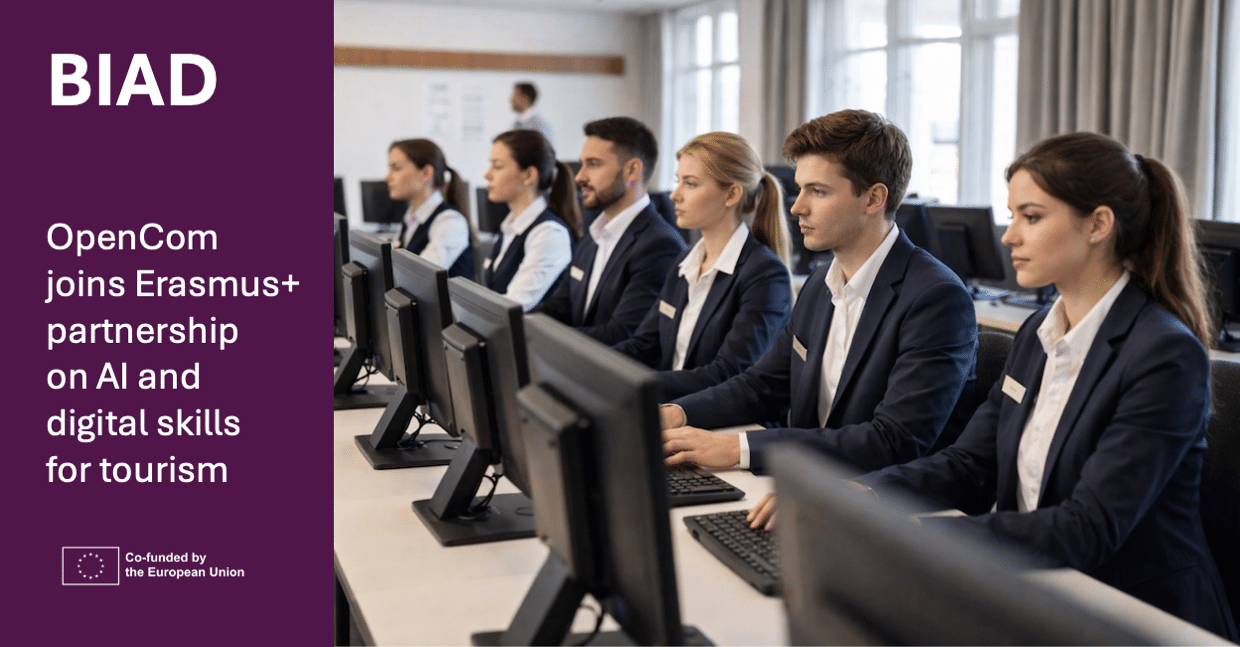
OpenCom has joined the BIAD consortium (AI-Enabled Skill-Building for Tourism and Hospitality: Bridging the Industry-Academia Divide), an Erasmus+ project bringing together 14 organisations from six countries. The project aims to develop next-generation training pathways for tourism and hospitality that combine artificial intelligence, digital skills, and environmental sustainability. Coordinated by Forma Camera, a special agency of the Rome Chamber of Commerce, BIAD runs for 36 months with a total budget of approximately €1.5 million.
Tourism and hospitality employ over 12 million people across Europe and account for 2.4 million businesses, nearly all of them SMEs. Yet the sector faces a widening gap between existing training provision and what the labour market actually demands: up-to-date digital skills, the ability to integrate new technologies into daily operations, and an awareness of sustainability. The pandemic accelerated this disconnect, making it all the more pressing to rethink how tourism professionals are trained. BIAD starts from precisely this point, building bridges between educators and employers.
At the heart of the project is an AI-powered skills monitoring system that tracks labour market trends and informs training development in real time. On this basis, the consortium will create 30 learning modules across three qualification levels (EQF 5, 6, and 7) and deliver them through an e-learning platform that combines hybrid learning, gamification, and interactive resources. All pathways will issue Europass-compatible micro-credentials recognised across borders. Training will be piloted in five countries with educators, students and professionals, with a particular focus on accessibility and gender inclusion.
“What makes this project especially compelling from a pedagogical standpoint is its adaptive approach to training,” observes Erina Guraziu, a researcher holding a PhD in Experimental Pedagogy. “This is not simply about transferring digital content into a tourism setting. The idea is to build pathways that respond to learners’ real needs, using artificial intelligence not as an end in itself but as a means to personalise learning and close gaps that traditional models can no longer reach.”
Within the consortium, OpenCom will contribute to curriculum design, the mapping and analysis of existing tourism education programmes across Europe, and the project’s quality assurance and data management framework. The cooperative will also play a central role in the testing phase, leading pilot session design and learner training across five countries, reaching 300 students and 150 SMEs. “For a cooperative like ours, with years of work in international training and mobility, joining a project like BIAD means bringing hands-on experience to the table,” explains Erina Guraziu, President of OpenCom. “This is ground we know well, and we believe we can make a meaningful contribution, particularly when ideas meet the reality of classrooms and local communities.”
The consortium brings together universities, research centres, chambers of commerce, business federations, and tourism operators from Italy, Spain, Turkey, France, Greece, and Germany, including Sapienza University of Rome, Ankara Yıldırım Beyazıt University, the Ionian University, and ACEEU, a German agency specialising in quality assurance for higher education.
BIAD started on 1 December 2025. The kick-off meeting takes place on 3 and 4 February 2026 in Rome, hosted by Forma Camera. Needs analysis and skills mapping across partner countries will begin in the coming months.
Funded by the European Union. Views and opinions expressed are, however, those of the author(s) only and do not necessarily reflect those of the European Union or the European Education and Culture Executive Agency (EACEA). Neither the European Union nor EACEA can be held responsible for them.