
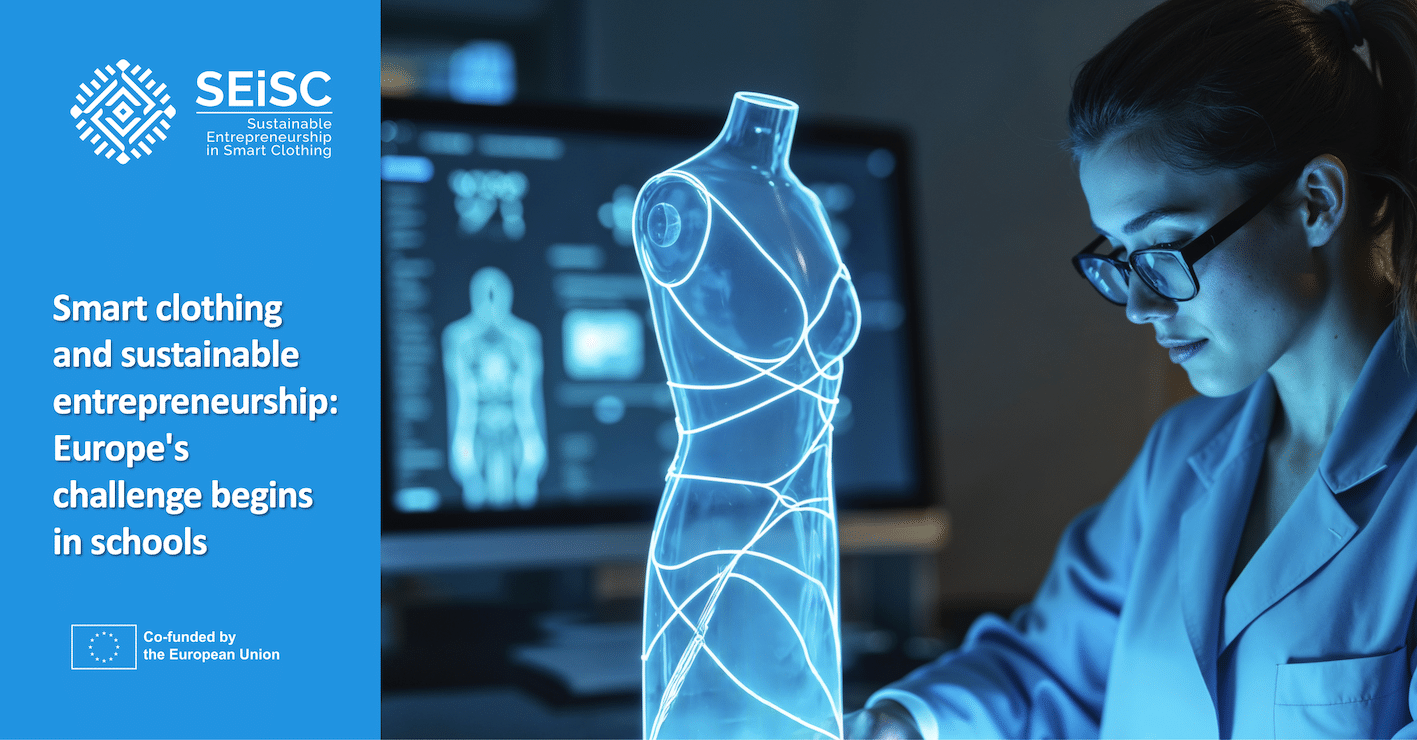
The global smart clothing market is experiencing explosive growth, redefining what we mean by “getting dressed”. Analysts valued the market at 5.16 billion dollars in 2024, with projections indicating a CAGR of 26.2% from 2025 to 2030. Fabrics are no longer simple coverings—they are becoming sophisticated technological devices.
The European project SEiSC (Sustainable Entrepreneurship in Smart Clothing) addresses this transformation by equipping vocational education students with the skills to navigate the challenges and opportunities of this emerging sector. The Erasmus+ funded initiative brings together VET institutions and technology partners from six European countries: Finland, Italy, Spain, Turkey, Ireland, and Bulgaria. The Finnish institution Lounais-Hämeen koulutuskuntayhtymä coordinates the partnership, which uses Artificial Intelligence-powered virtual simulations to foster a sustainable entrepreneurial mindset among students and boost their employability in a rapidly expanding market.
Smart clothing, also known as electronic textiles or intelligent fabrics, monitors the wearer’s health by tracking biometric data such as heart rate, body temperature, and muscle tension. This is no longer science fiction: the clothing segment led the market in 2024, capturing the largest share of revenue at 57.6%.
The sector continues to evolve towards increasingly sophisticated applications. Third-generation ultra-smart textiles can sense, respond to, and adapt to environmental conditions. They function as a “cognitive brain”, capable not only of monitoring but of reacting actively. Advances in sensor technology, wireless connectivity, and materials science have dramatically improved the functionality and usability of these products.
Yet the real potential lies in combining sustainability with technology—precisely the focus of SEiSC’s training approach. The project employs Artificial Intelligence algorithms to tailor learning pathways to each student’s needs, creating simulated scenarios that replicate the real dynamics of the sustainable fashion and smart clothing industry.
The smart clothing revolution extends beyond technology into culture: we are witnessing the emergence of a new paradigm where clothing becomes an interface between the human body and the digital world. For young people currently training in European vocational institutions, this transformation offers genuine career opportunities in a sector that unites innovation, sustainability, and entrepreneurship.
Find out more about the project: www.seisc.eu
Sources:
- Grand View Research, Smart Clothing Market Size, Share & Trends Analysis Report, 2024-2030
- Mordor Intelligence, Smart Clothing Market Analysis By Textile Type, 2024-2030