
Preparing teachers who can teach sustainable entrepreneurship is one of the least visible yet most pressing challenges facing European vocational education and training. Entrepreneurship itself is a moving target as a competence, sustainability calls for new lenses to read the world, and the sector where the two have to come together, smart clothing, is one of the most dynamic corners of European manufacturing. Equipping a teacher to hold these three planes together calls for a training design that cannot be packed into a single course.
The SEiSC project, Sustainable Entrepreneurship in Smart Clothing, has built that design in two stages. The project is promoted by LHKK, a Finnish vocational training institute, and brings together a consortium of VET and technology partners spread across six European countries. The first stage, completed in recent months, was the MOOC published on Open Academia: ten modules built around the European frameworks EntreComp, GreenComp and DigCompEdu, which have certified dozens of VET teachers on the theoretical and methodological foundations of sustainable entrepreneurship applied to smart clothing. The MOOC is free, delivered in English and open to VET teachers across Europe, available on Open Academia at https://openacademia.eu/courses/seisc-course. The second stage is the experiential training in Helsinki, which has just drawn to a close.
From 5 to 8 May 2026, the teachers selected from those who completed the MOOC gathered in Helsinki to put what they had studied into practice. The event was hosted by LHKK and 3DBear and built around three complementary lines of work.
The first line was Agora Lake, the virtual simulation platform developed by OpenCom, which sits at the technological heart of the project. Guided by Erina Guraziu of OpenCom, the teachers tested the adaptive learning path designed for their own students first-hand: a sustainability challenge set around an alpine lake to be tackled through Design Thinking, the Business Model Canvas, and the Triple Bottom Line. Going through the platform the way a student will is the only way to understand how to bring it into one’s own teaching.
The second line shifted register. Anu Kaseva of LHKK introduced the pedagogical escape room, a game-based learning method that does not require advanced technology but rather sophisticated instructional design. Every puzzle maps onto a learning objective; the game’s structure becomes pedagogical architecture. The teachers played before they designed, because only by going through the mechanism do you grasp how it works.
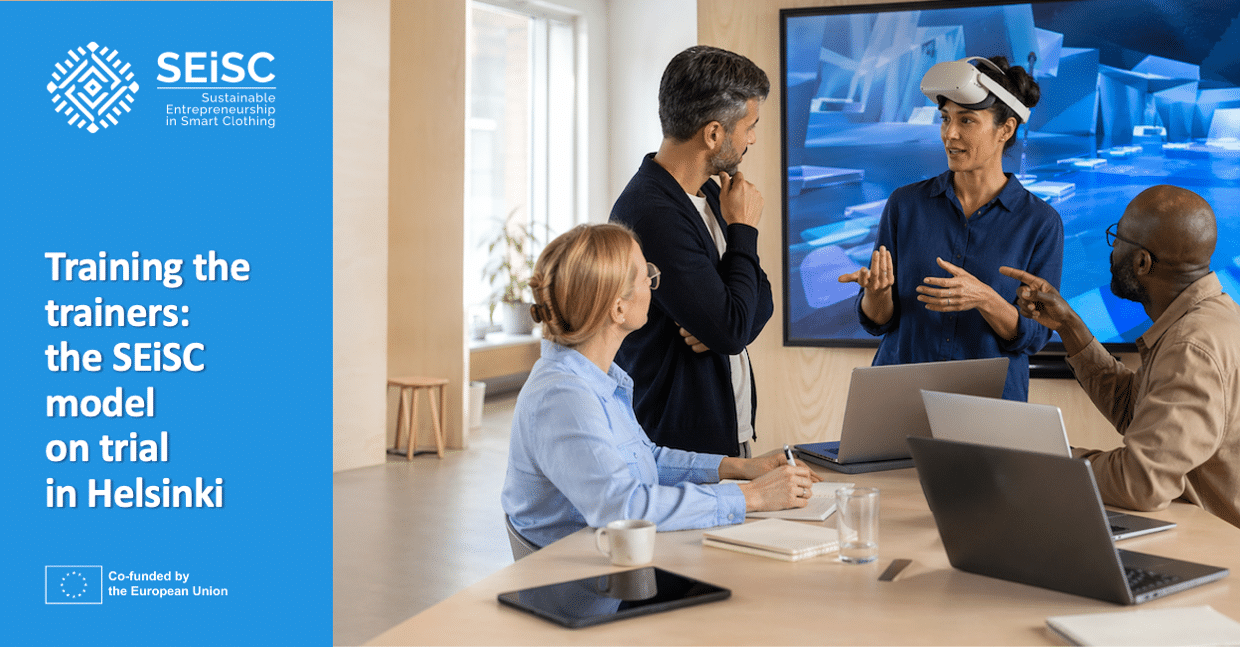
The third line, led by Pekka Salokannel of 3DBear, opened up the field of XR tools for teaching: immersive 360° simulations, AI-driven avatars, VR headsets, and virtual learning environments. A day that closed with the most demanding session of the whole week, with each teacher designing their own simulation-based lesson.
SEiSC draws to a close on 31 October 2026. In the months ahead, the Agora Lake platform will be finalised through an extended phase of testing with students and teachers from the six countries of the consortium, and the methodological guide to support teachers in integrating the platform into their teaching will be produced. What Helsinki delivers to the project, and what teachers carry back into their schools, is more than a week of training: it is an integrated model of teacher education, ready to be adopted, adapted and transferred.
Full information about the project is available at www.seisc.eu