
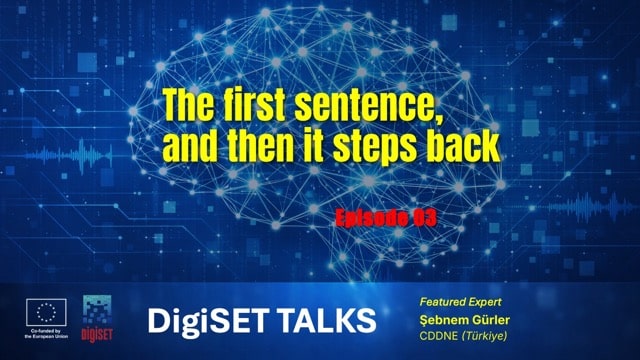
DigiSET Talks, the podcast of the DigiSET Erasmus+ Teacher Academy, is back with its third episode, The first sentence, and then it steps back, now on YouTube and on the project website. It is curated by the Çorlu District Directorate of National Education, a Turkish local education authority, which invited Şebnem Gürler, a Turkish language teacher at the Çorlu Science and Art Centre, as its featured expert. Its subject is a moment every teacher knows: the child who stares at a blank page and says, ‘I do not know how to start.’
In her writing lessons, Gürler saw that these children do not lack imagination, only a safe first step. Her answer is Let’s Write, a digital tool developed at her centre. The learner makes three simple choices, how, who and what happens, and the tool turns them into a single opening sentence, such as ‘Curiously, Nasreddin Hodja discovers a clock that tells stories.’ Then it steps back. Plot, voice, details and ending stay with the child, who remains the author, not the editor of a machine’s text.
Responsible design matters too, with learners aged 8 to 14. No live generative AI runs while the child writes, the images are reviewed by teachers before the lesson, and the tool works offline, without accounts, in both Turkish and English. The same restraint makes it digitally sustainable: reusable prompt pools instead of disposable worksheets, very little bandwidth, and content any school can adapt to its own culture. In a classroom pilot with 38 fourth-year primary pupils, those using the tool began writing in 32% less time and produced texts 47% longer, while 85% said they enjoyed writing, against 40% of the other group. These are descriptive classroom findings, not causal proof. Gürler’s message to teachers is simple: technology should not take the pen from the child, it should make the first mark feel possible.
Behind the series stands DigiSET, the Digitally Sustainable European Teacher Academy funded under the Erasmus+ programme, which brings together 16 partners across eight countries, coordinated by the University for Continuing Education Krems. The project supports teachers in developing a new competence profile, one that holds together digital ability, environmental awareness and the personal and social skills needed to teach in a changing world. It works through three tools, a community of practice, a massive open online course and a virtual simulation platform, along a path that moves teachers from learners to developers and, finally, to ambassadors of change.
One choice ties the form of the podcast to the themes of the project: the episodes are made with artificial intelligence, openly and deliberately. This is not a technical gimmick, it is part of the message. The method developed to produce them, from reading the source materials to generating the voices, will become part of the pool of experience available to the teachers of the Academy, who can reuse and adapt it for their own teaching. In this way the podcast is not simply a communication product, it becomes a method others can repeat, and it extends the project value well beyond its end date.
The series is produced by OpenCom, which leads the project communication, while overall scientific oversight rests with the University of Siena. Each episode is then curated by a different consortium partner, who invites an expert to provide its scientific content. This third episode is curated by the Çorlu District Directorate of National Education, with Şebnem Gürler as its featured expert. Future releases will follow the rhythm of the project, giving voice to the themes and research of its different partners.
The third episode is available on:
YouTube: https://youtu.be/xTGmd-TFHNQ?si=V02BEfOIsdb_Aawn
Website: https://digisetproject.eu/podcast/
EPALE: https://epale.ec.europa.eu/en/node/425008
DigiSET project, digisetproject.eu. Co-funded by the European Union. Views and opinions expressed are those of the author(s) only and do not necessarily reflect those of the European Union or the EACEA.