
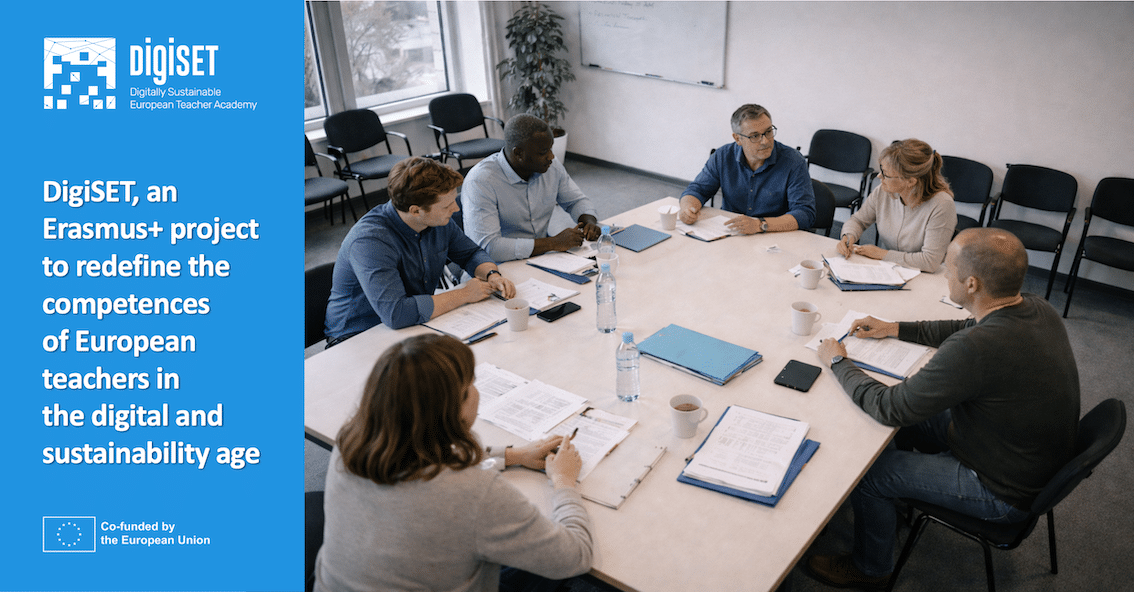
DigiSET, an Erasmus+ Teacher Academy project to redefine the competences of European teachers in the digital and sustainability age.
Think of the last teacher who changed something in you. Chances are, it wasn’t the one who knew the most about their subject. It was the one who knew how to stand in a room with twenty very different people and make sure every single one of them walked away having learnt something. That room has changed. Today, it is full of students who use AI to do their homework, who are growing up in a world that demands both digital fluency and environmental awareness, and who arrive at school with far more varied learning needs than any generation before them. The question is simple: who is preparing teachers for that room?
The data suggest the problem is both real and widespread. According to Eurostat, in 2023, only 55% of the European population aged 16 to 74 had basic digital skills. Among those who are supposed to be teaching those skills, the picture is no more reassuring: national studies carried out in Austria, Germany and Switzerland found that between 10% and 30% of teachers consider their own digital competences insufficient. The 2023 European Commission/EACEA/Eurydice report records that more than half of European education systems have made digital competences compulsory in initial teacher education. Making something compulsory, however, is not the same as making it happen.
The issue, though, goes beyond technology. European schools are being asked to respond to two major transformations at once: the digital and the environmental. In-service training systems almost invariably tackle them separately, with tools designed for a different era. Individual European frameworks already exist for each of these dimensions: DigCompEdu for teachers’ digital competences, GreenComp for sustainability, LifeComp for transversal life skills. What has not yet been attempted, at European scale and within a single certifiable training pathway, is bringing all three together in a structured, transnational programme specifically designed for teachers. That is the gap DigiSET is built to fill.
DigiSET, which stands for Digitally Sustainable European Teacher Academy, is a project co-funded by the European Union under the Erasmus+ Teacher Academies programme (project no. 101249272). Teacher Academies are a specific instrument within Erasmus+ designed to develop innovative approaches to teacher education at a transnational scale: not straightforward courses, but permanent structures for professional learning and collaboration. DigiSET was selected under this strand and launched on 1 January 2026, with a duration of thirty-six months and a budget of €1,500,000.
The model DigiSET does not provide another refresher course. DigiSET is an Academy, in the most precise sense of the word: a permanent learning structure organised around three distinct and progressive technological components. The first is an online platform that will evolve, over the course of the project, into a transnational Community of Practice, a shared space for exchange, collaboration and continuous professional development among European teachers. The second is a MOOC, a structured online course delivering the theoretical training on the project’s core themes. The third is the most complex and innovative component: an AI-based virtual simulation environment in which teachers do not simply engage with ready-made scenarios but have access to all the tools needed to develop their own virtual simulation scenarios as Open Educational Resources.
This third component defines the logic of the entire learning journey. A teacher who joins the Academy is not merely a recipient of content: they move through three distinct phases. As a learner, they acquire the competences set out in the framework. As developers, they apply those competencies by creating original virtual simulation scenarios on the project’s themes. As ambassadors, they bring what they have built into their own educational contexts and pass it on to fellow teachers, multiplying its impact well beyond the consortium’s boundaries. It is this cycle that turns a three-year project into a structure that outlasts its funding.
The framework is built on the integration of three existing European standards: DigCompEdu, the European framework for teachers’ digital competences; LifeComp, which addresses transversal life skills; and GreenComp, the European sustainability competence framework. The four thematic areas of the training programme are: the ethical and non-discriminatory use of artificial intelligence in teaching; systems thinking applied to sustainability; AI for adaptive learning; and the inclusion of students with specific learning difficulties, and the creation and sharing of Open Educational Resources. Certification is designed to work either as a full profile or area-by-area, as micro-credentials recognisable within national systems, in line with the Council of the European Union Recommendation of 25 May 2022 on micro-credentials for lifelong learning.
The work is being carried forward by a consortium of sixteen organisations across eight countries, led by the University for Continuing Education Krems in Austria. The composition is deliberately mixed: research universities, vocational training institutes, teachers’ unions, schools and operational organisations. The training programme itself will be implemented across seven of those countries, Austria, Bulgaria, Ireland, Italy, Romania, Spain and Turkey, each recruiting one hundred teachers and contending with education systems, infrastructures and national policies that differ considerably from one another. Norway contributes to the consortium through its expertise in competence frameworks and micro-credential certification, adding a perspective from outside the EU that strengthens the transferability of the results. It is precisely that breadth, institutional, geographic and systemic, which gives the project a credible chance of producing something workable at European scale.
By the end of 2028, DigiSET aims to have certified 700 teachers. The framework will be assessed by policymakers, trade unions and training providers in each partner country, with the explicit goal of easing its integration into national continuing professional development programmes. Once the project concludes, the Academy will remain operational: the three technological components will stay accessible, the trained teachers will continue to act as ambassadors and trainers, and new teachers will be able to enter a system that no longer depends on the original funding to function.
The real test, however, cannot be measured in certificates. It will be measured by how many national training systems, once the project is over, are genuinely willing to take its results on board. DigiSET builds a tool. Whether that tool finds a place in European schools will depend on the quality of the work, on institutions’ willingness to use it, and on whether an entire generation of teachers can recognise themselves in a professional profile that does not yet fully exist, but that someone has decided it is time to start building. The work has only just begun.